Apple's ECG app tells you about rhythm. It does not show the intervals, the small timings inside each heartbeat that clinicians routinely measure on an ECG. Those timings are there in your recording, and they are worth understanding. Each one tells you how long a particular step of the heartbeat took.
The intervals at a glance
| Interval | What it measures | Typical adult range |
|---|---|---|
| R-R | Time from one beat to the next | 600 to 1,000 ms at 60 to 100 bpm |
| PR | From atrial activation to ventricular activation | About 120 to 200 ms (some references use 100 ms as the lower limit) |
| QRS | Ventricular activation | About 70 to 100 ms, 120 ms or more is considered wide |
| QT | Ventricular activation and recovery | Depends on heart rate |
| QTc | QT corrected for heart rate | About 350 to 450 ms in men, 360 to 460 ms in women |
These ranges come from clinical references.123 They describe typical adults and differ slightly between sources, so treat them as general guides rather than exact cut-offs.
R-R interval
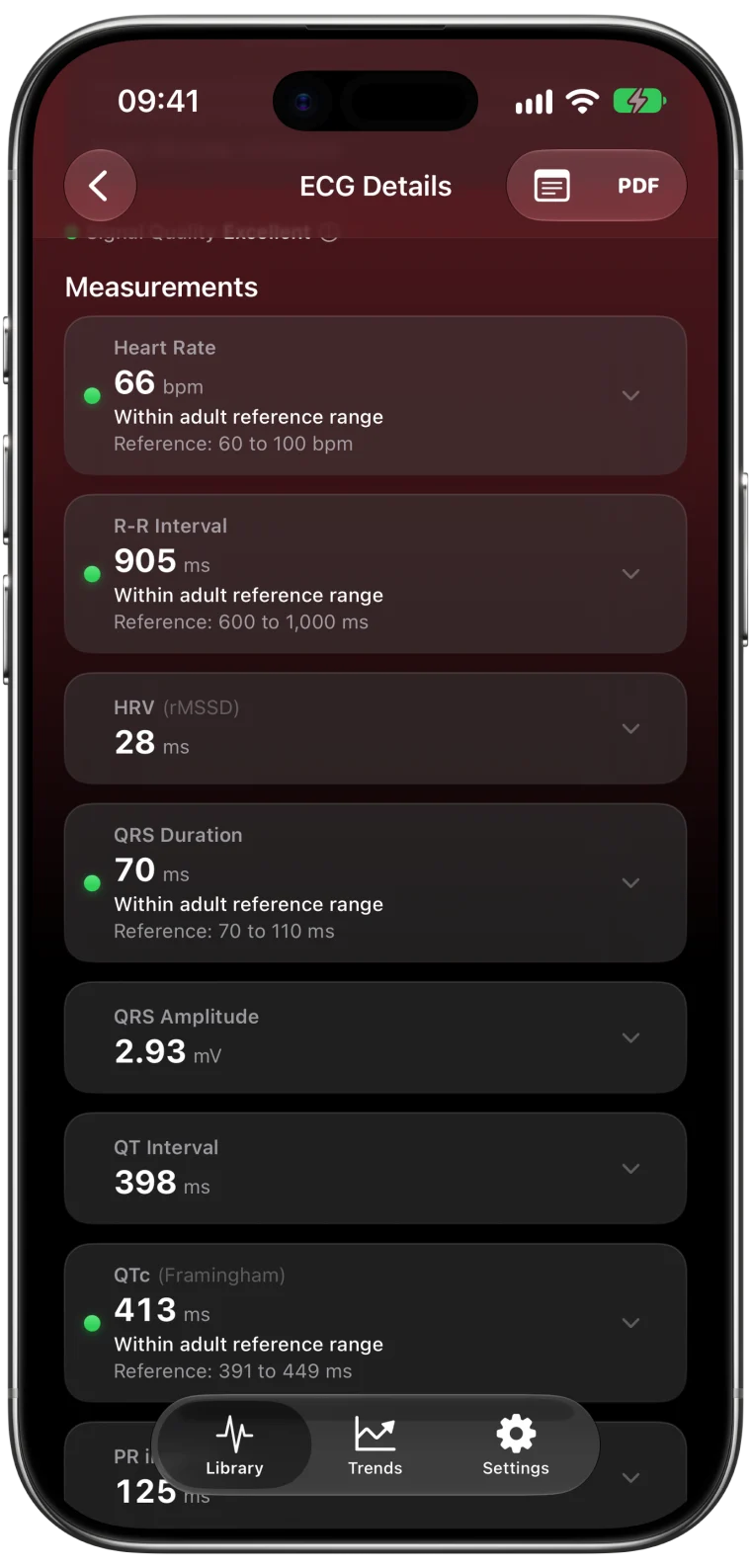
R-R is the time between two consecutive QRS spikes. It is the basis of heart rate: 60,000 divided by the R-R interval in milliseconds gives beats per minute. An R-R of 1,000 ms is 60 bpm, and 600 ms is 100 bpm.
R-R intervals are never perfectly equal. They lengthen and shorten slightly as you breathe, which is a normal variation and the raw material for HRV.4
P wave and PR interval
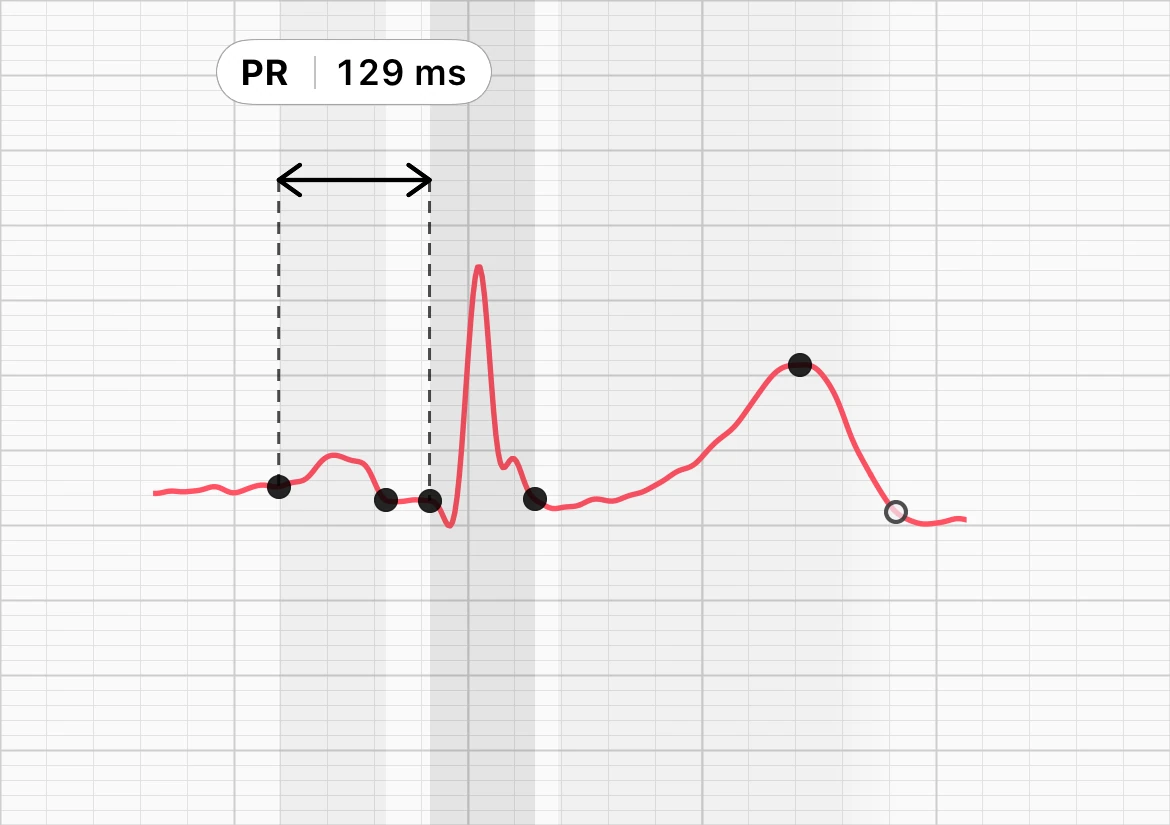
The P wave is the small bump before each QRS, when the upper chambers are activated. It usually lasts less than about 120 ms. The PR interval runs from the start of the P wave to the start of the QRS and is typically about 120 to 200 ms. Both need a clear P wave, which is small on a single-lead recording. The P wave guide and the PR interval guide show each one marked on a real beat.
QRS duration and amplitude
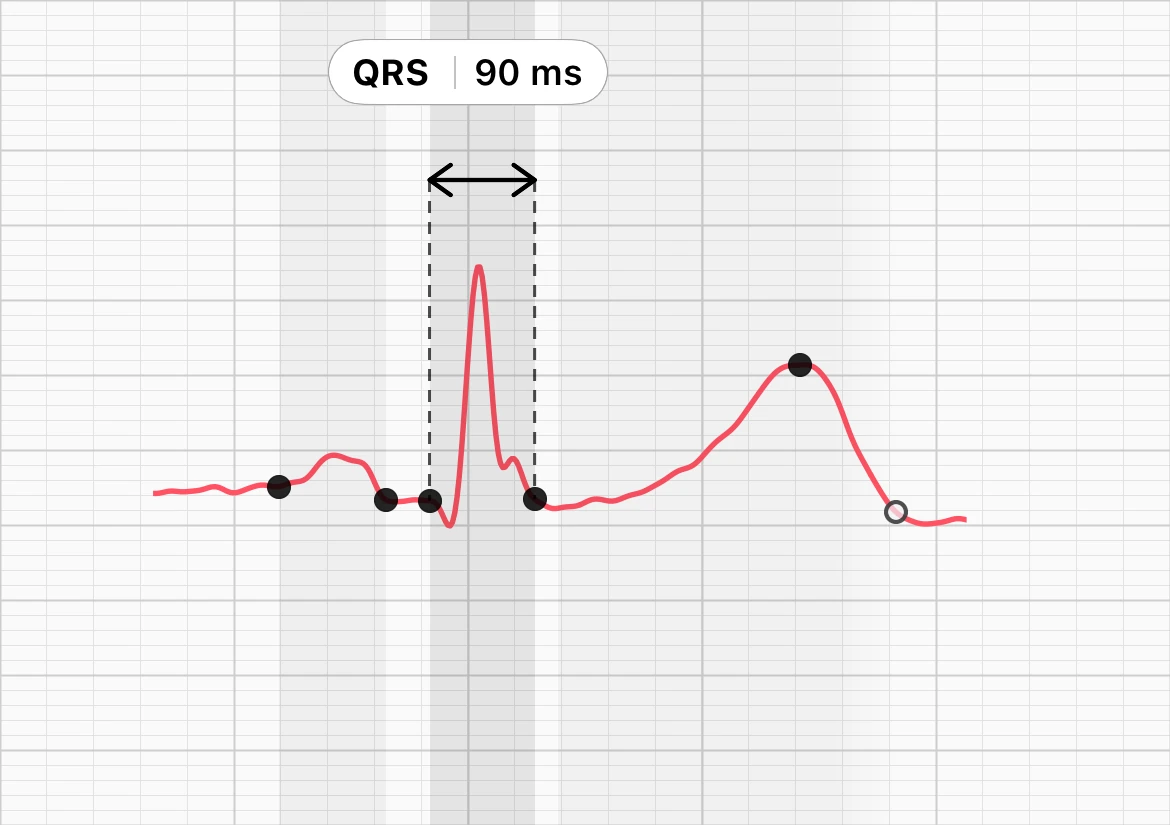
The QRS is the tall spike of each beat, when the lower chambers are activated. It typically lasts about 70 to 100 ms, and 120 ms or more is considered wide. Its height, the QRS amplitude, describes the recorded signal rather than how strongly the heart pumps. The QRS duration guide and the QRS amplitude guide explain both with a real beat.
QT interval and QTc
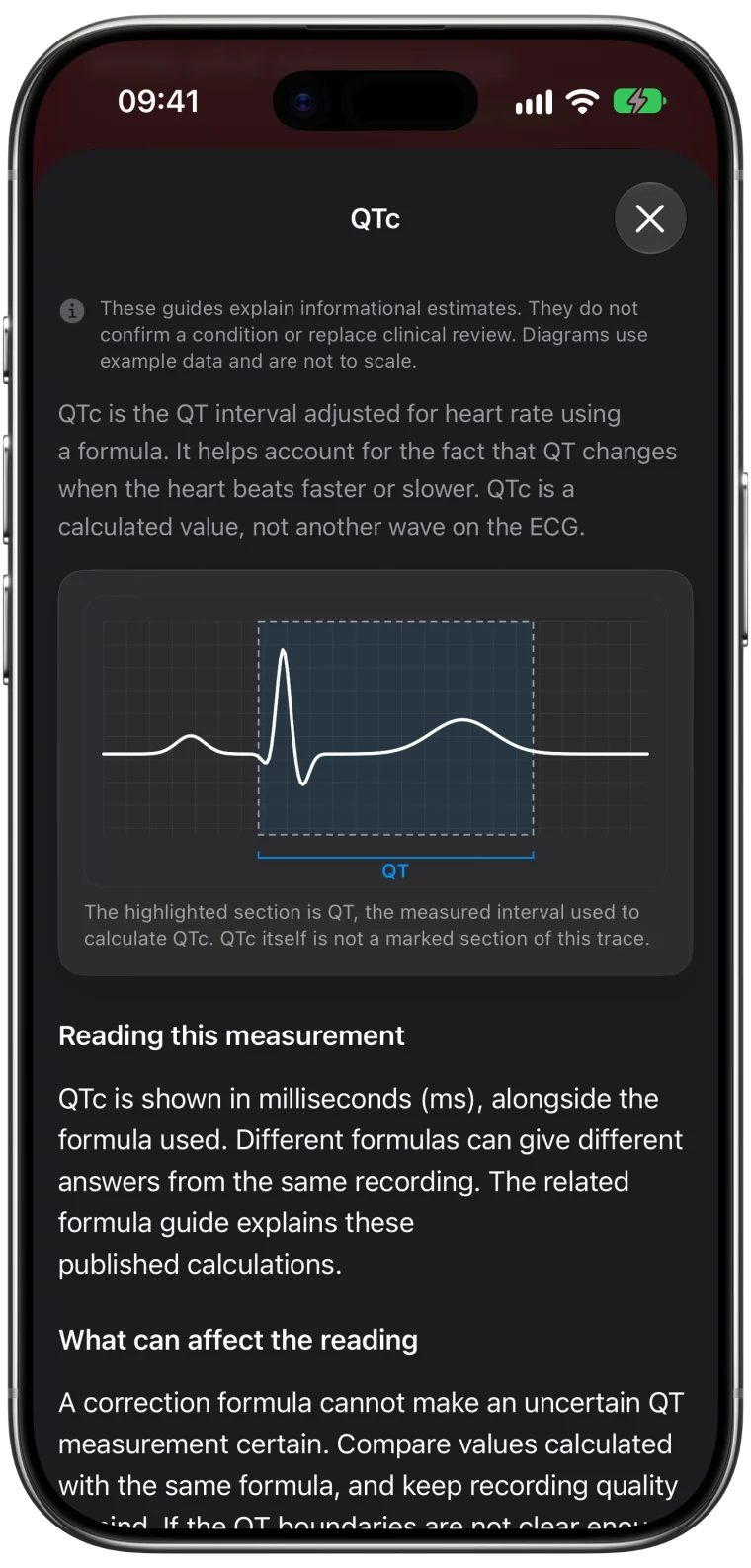
QT runs from the start of the QRS to the end of the T wave. It covers both activation and recovery of the ventricles. Because QT naturally shortens as heart rate rises, it is corrected for heart rate to give QTc, which can be compared across recordings.
QT is the hardest interval to measure precisely, for software and for people, because there is more than one accepted way to find the end of the T wave. The two common methods differ by about 10 ms, and even specialists can disagree by much more.5 The QTc guide explains the formulas, ranges and why values differ between apps.
Can an Apple Watch ECG measure intervals?
Research has compared intervals measured by hand on Apple Watch recordings with lead I of a 12-lead ECG. In one study of 43 healthy volunteers, the average differences were small, about 5 ms for PR, 7 ms for QRS and 11 ms for QT, though individual recordings differed more.6 Another study of 100 patients could measure QT on the watch recording in 85% of patients.7
These studies measured by hand and do not validate any particular app. What they show is that a single-lead watch recording often contains enough detail to estimate intervals, and that some recordings do not.
What affects your intervals
- Heart rate. QT is strongly affected, PR less so.
- Recording quality. Noise hides small waves, especially P waves and the end of T.
- Lead. Some waves are smaller on lead I than on other leads. QT can also differ between leads.3
- Medicines and salts in the blood. Some medications and electrolyte changes lengthen QT.
- Age and sex. QTc tends to be slightly longer in women.
In ECG Tracker+, each interval is shown only when the recording supports it. When a landmark is unclear, the value is marked unavailable instead of guessed. The measurement availability guide explains why.
A value outside a typical range is not a diagnosis, and a value inside it does not prove your heart is healthy. If a measurement concerns you, a clinician can check it on a 12-lead ECG.
Frequently asked questions
What is a normal PR interval?
In adults, the PR interval is typically about 120 to 200 ms. Some references use 100 ms as the lower limit. A PR longer than 200 ms is called first-degree AV block.
What is a normal QRS duration?
A typical QRS lasts about 70 to 100 ms. A QRS of 120 ms or more is considered wide and is worth discussing with a clinician.
Does the Apple Watch show my PR interval?
Apple's ECG app does not display intervals. ECG Tracker+ estimates PR, QRS, QT and QTc from your Apple Watch recordings when the waves are clear enough.
Sources
- LITFL: PR interval
- Merck Manual Professional: Electrocardiography
- Postema PG, Wilde AAM: The measurement of the QT interval, Current Cardiology Reviews 2014
- Shaffer F, Ginsberg JP: An overview of heart rate variability metrics and norms, 2017
- ESC CardioGenomics Insights: How to measure the QT interval
- Saghir N et al.: A comparison of manual electrocardiographic interval and waveform analysis in lead 1 of 12-lead ECG and Apple Watch ECG, 2020
- Strik M et al.: Validating QT-interval measurement using the Apple Watch ECG, Circulation 2020