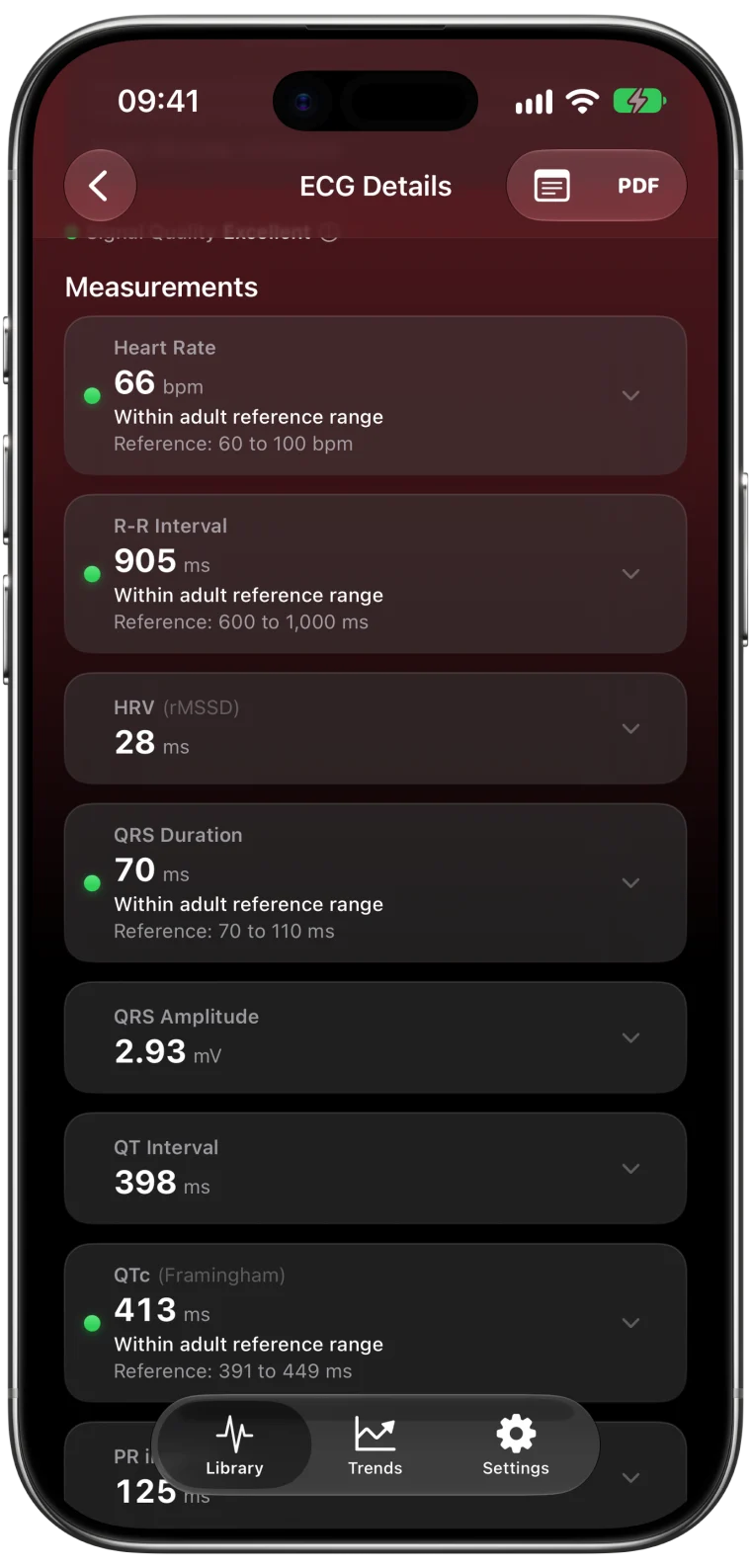
You open an ECG, the waveform looks clean, and yet QTc shows a dash. It is tempting to assume something broke. Usually nothing did. A measurement is only reported when the recording contains what that measurement needs, and a 30-second single-lead strip does not always provide every landmark.
First, identify which kind of "missing" it is
Missing values come in a few distinct states, and each has a different next step.
| What you see | What it means | What to do |
|---|---|---|
| The whole recording is missing | It was never imported | Check Health, filters and import settings |
| A value is locked | The recording has not been fully analyzed on your plan | Use one of your three free analyses this month, or Pro |
| Analysis is still running | The result is not ready yet | Keep the app open and let it finish |
| A value is unavailable | The recording cannot support it | Tap the value to read the reason |
| A value is marked as an estimate or manual | It needs its label to be read correctly | Keep the label with the number when you share it |
A free analysis or Pro can unlock a measurement the recording supports. It cannot create a value that the signal does not contain.
Why one measurement can be missing while others are not
Every interval is measured between two landmarks on the waveform. If one landmark is unclear, that interval cannot be measured with confidence, even when the rest of the recording is fine.
- Heart rate and R-R need clearly visible R peaks, the tall spikes. They are the most robust values and are usually available.
- QRS duration needs a clear start and end of the QRS complex.
- PR interval needs a visible P wave before each QRS. If P waves are small, hidden in noise or absent, as they are in atrial fibrillation, PR cannot be measured.1
- QT and QTc need the end of the T wave. That end can be gradual and hard to place, especially when T waves are flat or low. Even specialists disagree about exact T-wave endpoints on difficult tracings.2
- HRV needs a run of regular beat-to-beat intervals. Premature beats, missed beats and noise interrupt that run, so a strip with frequent extra beats may not support an HRV value.3
A missing value is not a missing heartbeat feature
An unavailable QT does not mean your heart has no T wave, just as a missing PR does not mean there were no P waves. It means this particular recording, from this particular angle and with this signal quality, did not show the feature clearly enough to measure it.
The Apple Watch records a single lead, roughly equivalent to lead I on a clinical ECG. Some waves that are small in lead I look much larger on other leads, which is one reason a clinician's 12-lead ECG can measure what a watch strip cannot.4
When a new recording may help
If the reason points to noise or movement, a calmer recording often fixes it. Sit down, rest your arms on a table, keep the Watch snug and stay still for the full 30 seconds. The guide to a cleaner Apple Watch ECG covers the details.
If the reason is about the waveform itself, such as a very flat T wave, a new recording may show the same thing. That is useful information too, and worth mentioning if you discuss the recordings with a clinician.
Keep the earlier recording either way. A new ECG is a new 30-second sample, not a corrected copy of the old one.
How missing values show up in Trends
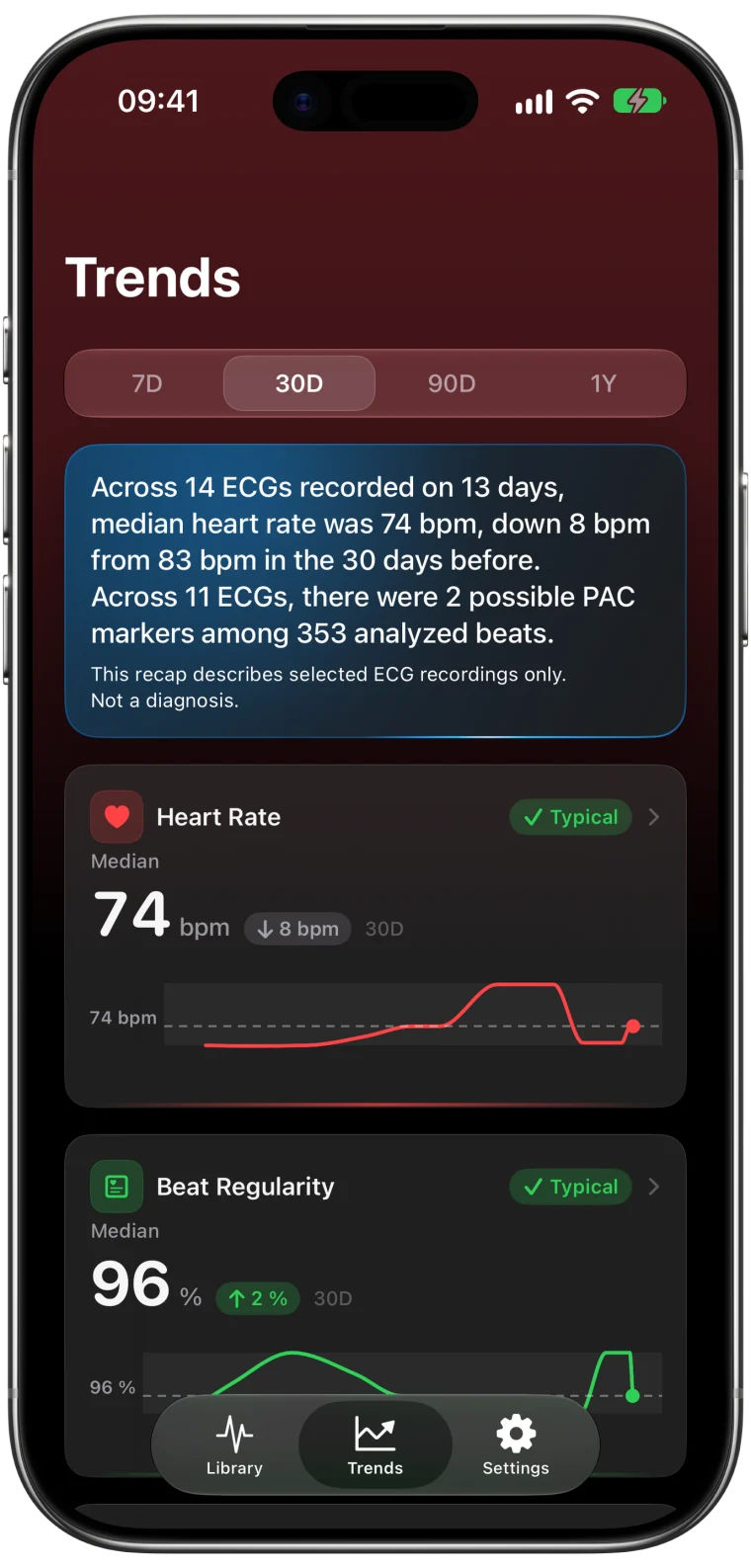
Imagine five ECGs in a week, where only three have a QT value. Trends then summarizes three QT values for that week. The other two recordings are simply absent from the QT chart. They are not counted as zero, so they do not drag the median down.
This is why a chart can show fewer points than you have recordings. When you compare two periods, check how many values each one actually contains. The Trends guide shows how to open the recordings behind a point.
Whether the app can show a value says nothing about whether you need medical attention. If you have symptoms, contact a healthcare professional regardless of what the recording shows.
Frequently asked questions
Why is QTc missing on my Apple Watch ECG?
QTc needs a measurable QT interval, and QT needs a clear end of the T wave. Flat T waves, noise or an irregular rhythm can make that end too uncertain to measure in a 30-second single-lead recording.
Why is PR interval not shown when my rhythm is atrial fibrillation?
PR is measured from the start of the P wave to the start of the QRS. In atrial fibrillation there are no organized P waves, so there is no PR interval to measure.
Will unlocking the recording show the missing measurement?
Unlocking a recording, with a free analysis or with Pro, shows every measurement it supports. If a value is unavailable because the signal does not show the needed landmark, nothing can produce it.