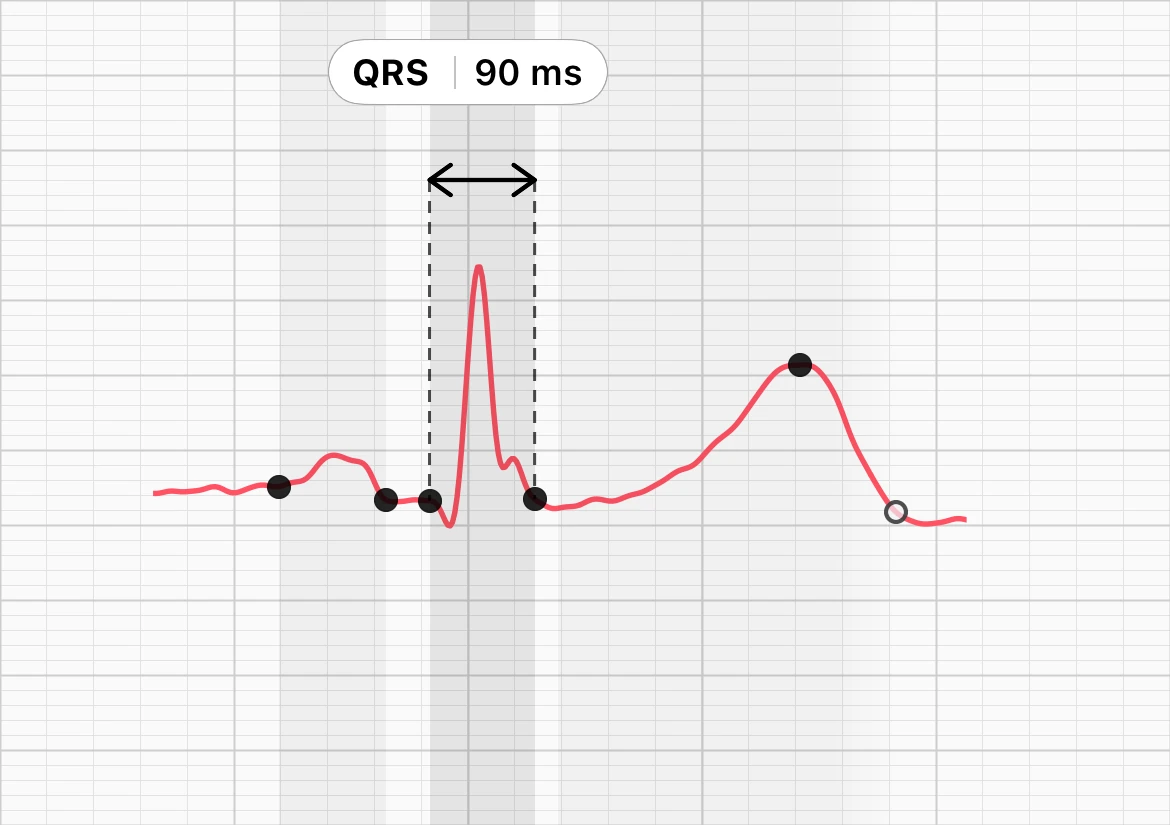
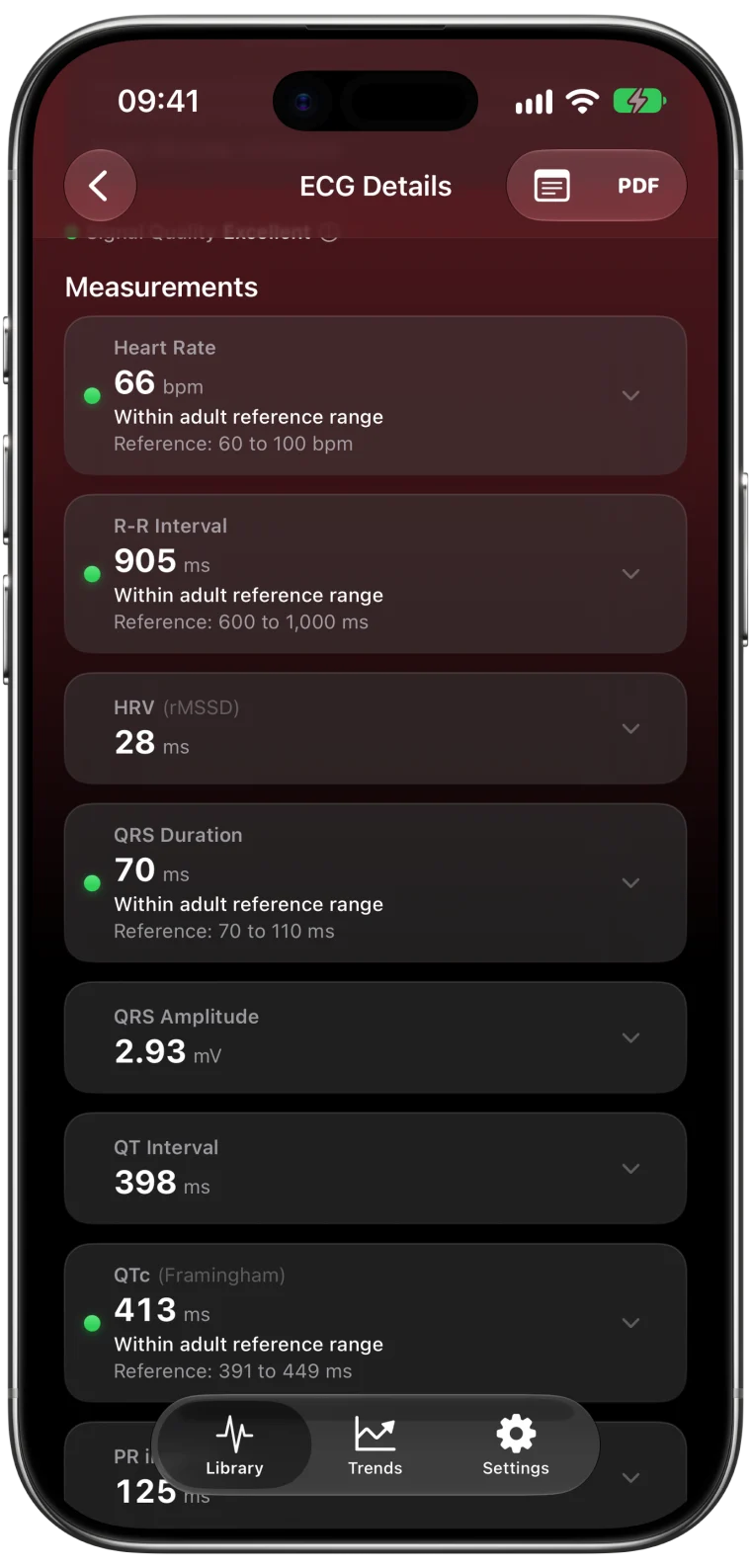
Most of the time, the QRS spike is narrow and sharp. The signal races down a fast conduction system and activates the lower chambers in a fraction of a second. When that pathway is slowed or bypassed, the spike stretches out. That is a wide QRS, and here is what it looks like on a real single-lead recording.
What makes a QRS wide
The QRS shows the ventricles, the lower chambers, being activated. Normally the signal travels down two fast branches, the right and left bundle branches, and the QRS lasts about 70 to 100 ms.1 A QRS of 120 ms or more is considered wide.2
Common reasons include:2
- Bundle branch block. One of the two branches conducts slowly or not at all, so that side of the heart is activated late, cell by cell. This can be a right or a left bundle branch block.
- Beats that start in the ventricles, such as a PVC.
- A pacemaker that paces the ventricles.
- Some medicines and high potassium levels, which slow conduction through the heart muscle.
A real example
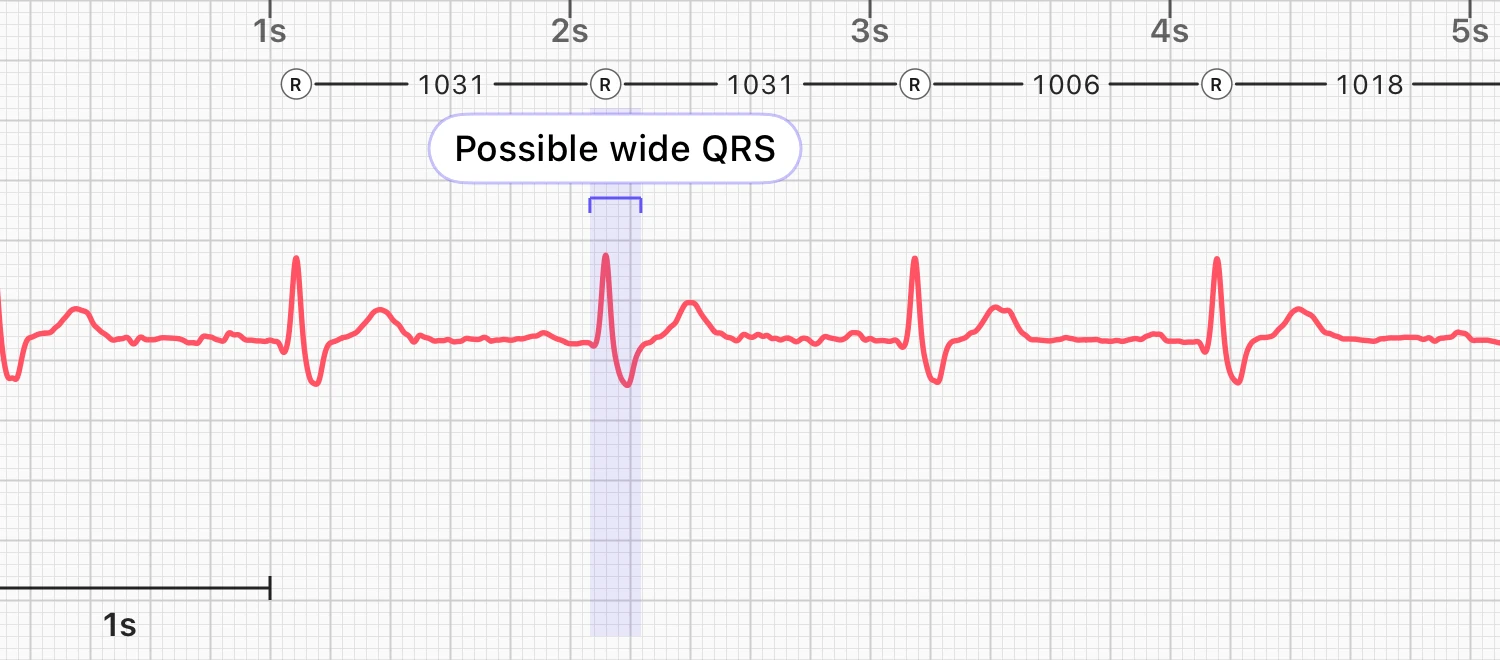
This is a real recording in lead I, the lead closest to what an Apple Watch records. The cardiologists who read the full 12-lead ECG reported a complete right bundle branch block. ECG Tracker+ analyzed lead I only, with the same analysis it runs on your recordings, and marked a possible wide QRS.
The rhythm itself is regular, at about 58 bpm. What stands out is the shape of each beat. After the upward spike comes a broad, slurred downward wave before the line returns to the baseline. In right bundle branch block, that wide, slurred S wave is typical of lead I.3
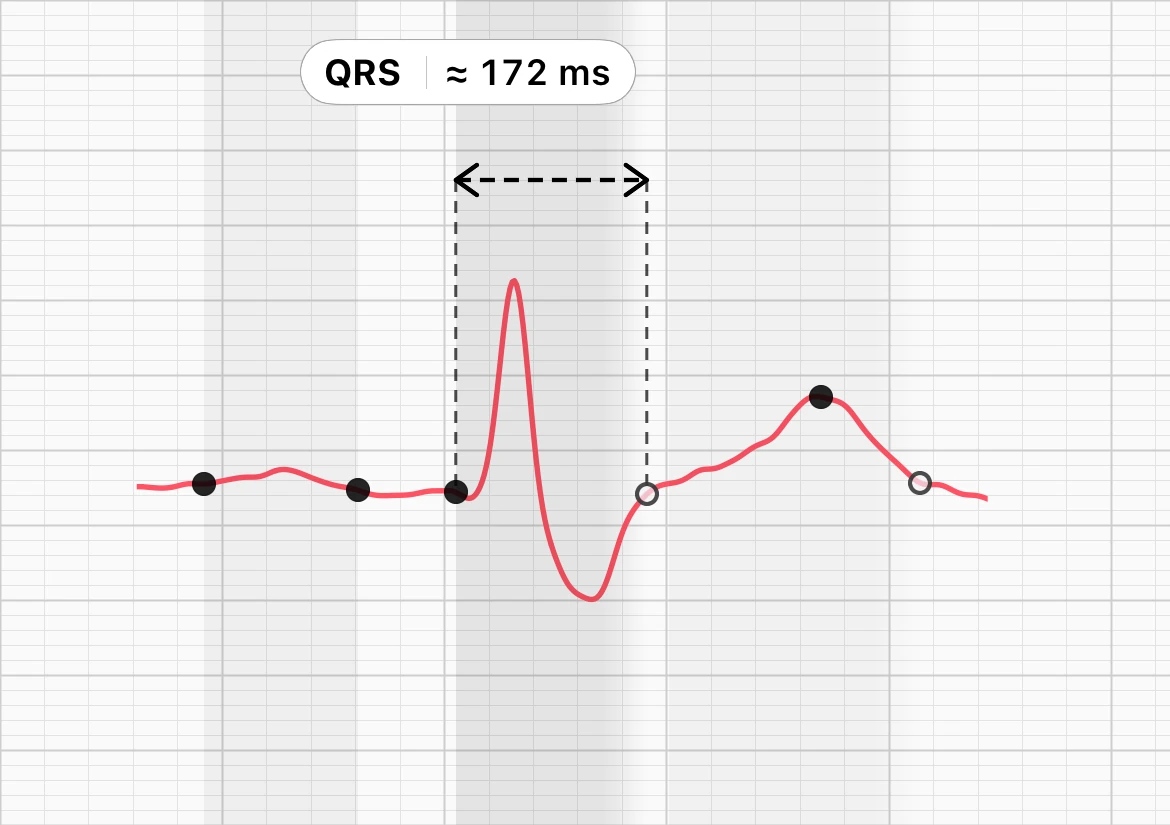
On one beat, the app measured a QRS of about 172 ms, from the first rise of the spike to the end of the broad S wave. A typical QRS is less than 100 ms.
How ECG Tracker+ decides
A single wide-looking beat is not enough. ECG Tracker+ measures the QRS on each beat that looks like the others, takes the median across the recording and marks a possible wide QRS only when that median is 120 ms or more. It then highlights one representative beat on the waveform so you can see what was measured.
A single wide early beat, such as a PVC, is marked as a possible extra beat instead.
What one lead cannot tell you
A 12-lead ECG shows the QRS from many angles, which is how clinicians tell a right bundle branch block from a left one, or from other causes.3 One lead cannot do that. Part of the QRS can also run close to the baseline in lead I, so the measured width on a watch recording can differ from a 12-lead measurement.4
That is why ECG Tracker+ calls it a possible wide QRS. It is a cue to show a clinician, not a diagnosis.
Is a wide QRS serious?
It depends on the cause and on you. A right bundle branch block can happen in healthy people, and without symptoms or heart disease it is usually not serious.5 A left bundle branch block is more often linked with an underlying heart condition and usually leads to further tests.6 A new wide QRS, especially with symptoms, always deserves a clinician's view.
Call emergency services for chest pain, fainting, severe shortness of breath or a very fast or very slow heartbeat. If a possible wide QRS appears on your recordings and you have not discussed it before, bring the recordings to a clinician, who can confirm it on a 12-lead ECG.
Frequently asked questions
What is a normal QRS duration?
A typical adult QRS lasts about 70 to 100 ms. A QRS of 120 ms or more is considered wide.
Can an Apple Watch detect bundle branch block?
Apple's ECG app does not report bundle branch block. A watch recording can show that the QRS is wide, but telling a right from a left bundle branch block needs a 12-lead ECG.
Why did ECG Tracker+ mark a possible wide QRS on only one beat?
The app decides from the median QRS width across the recording, then highlights one representative beat. In a recording like the example, most beats are wide, not only the highlighted one.
Should I record again?
A few more recordings, made the same way, show whether the wide QRS is consistent. Keep them all and bring them to a clinician, who can check with a 12-lead ECG.
Sources
- Merck Manual Professional: Electrocardiography
- LITFL: QRS interval
- LITFL: Right bundle branch block (RBBB)
- Saghir N et al.: A comparison of manual electrocardiographic interval and waveform analysis in lead 1 of 12-lead ECG and Apple Watch ECG, 2020
- Cleveland Clinic: Right bundle branch block
- LITFL: Left bundle branch block (LBBB)