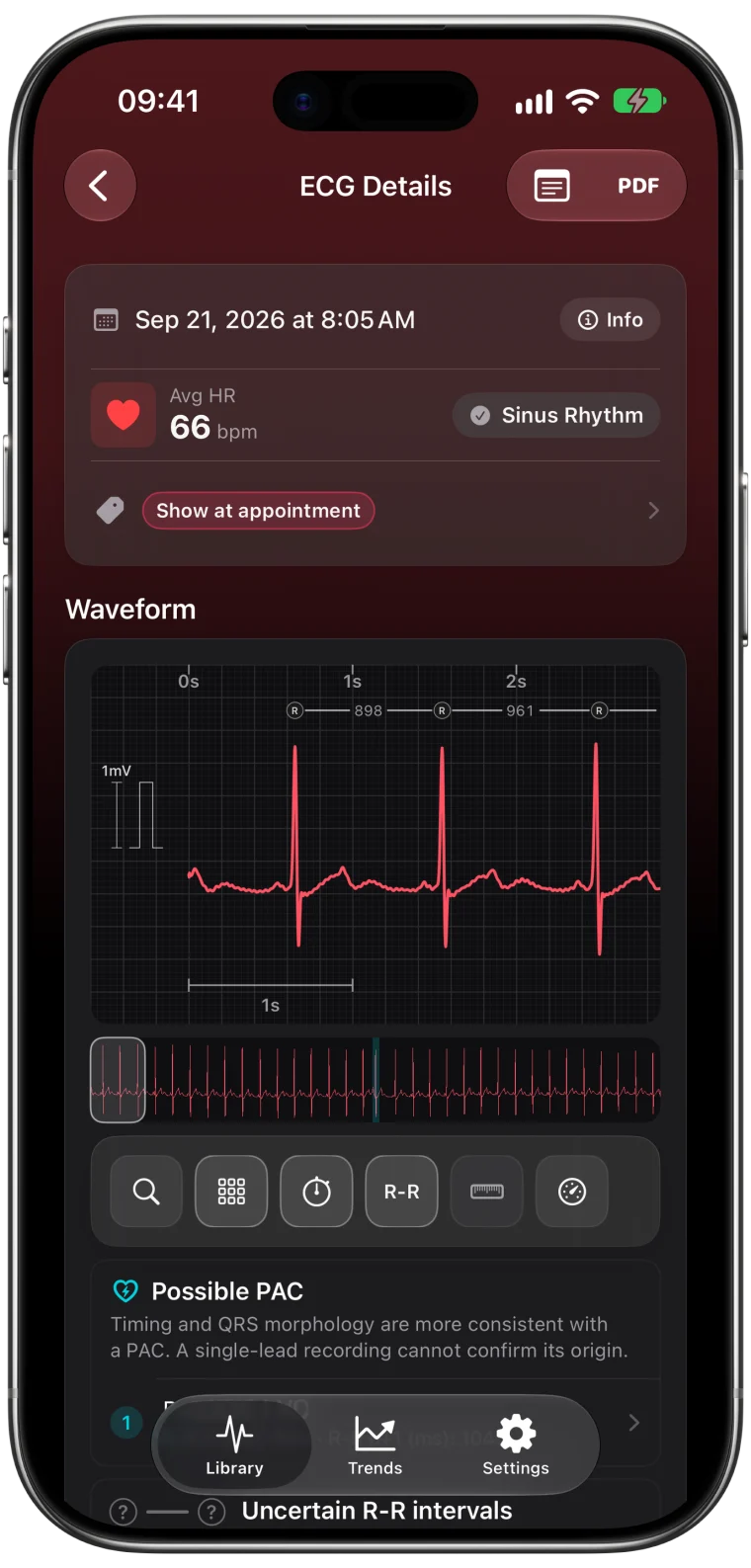
"Is my Apple Watch ECG as good as the one at the doctor's office?" It is one of the most common questions about the feature. The honest answer is that it is a different tool. The Watch captures a real electrical recording of your heart. It just captures it from one direction, for a short time.
What a "lead" is
An ECG lead is a view of the heart's electrical activity between two points on the body. Each lead sees the heart from a different angle, a bit like cameras placed around a room.
A standard 12-lead ECG uses electrodes on the chest, arms and legs to record twelve views from different angles. The Apple Watch uses two points, the back of the Watch on one wrist and a fingertip of the other hand on the Digital Crown. The result is similar to lead I, the view across the chest from one arm to the other.1
What a single lead captures well
- Heart rate across the recording
- Rhythm, whether beats are regular or irregular, which is how the Watch checks for AFib
- Timing between beats, the R-R intervals
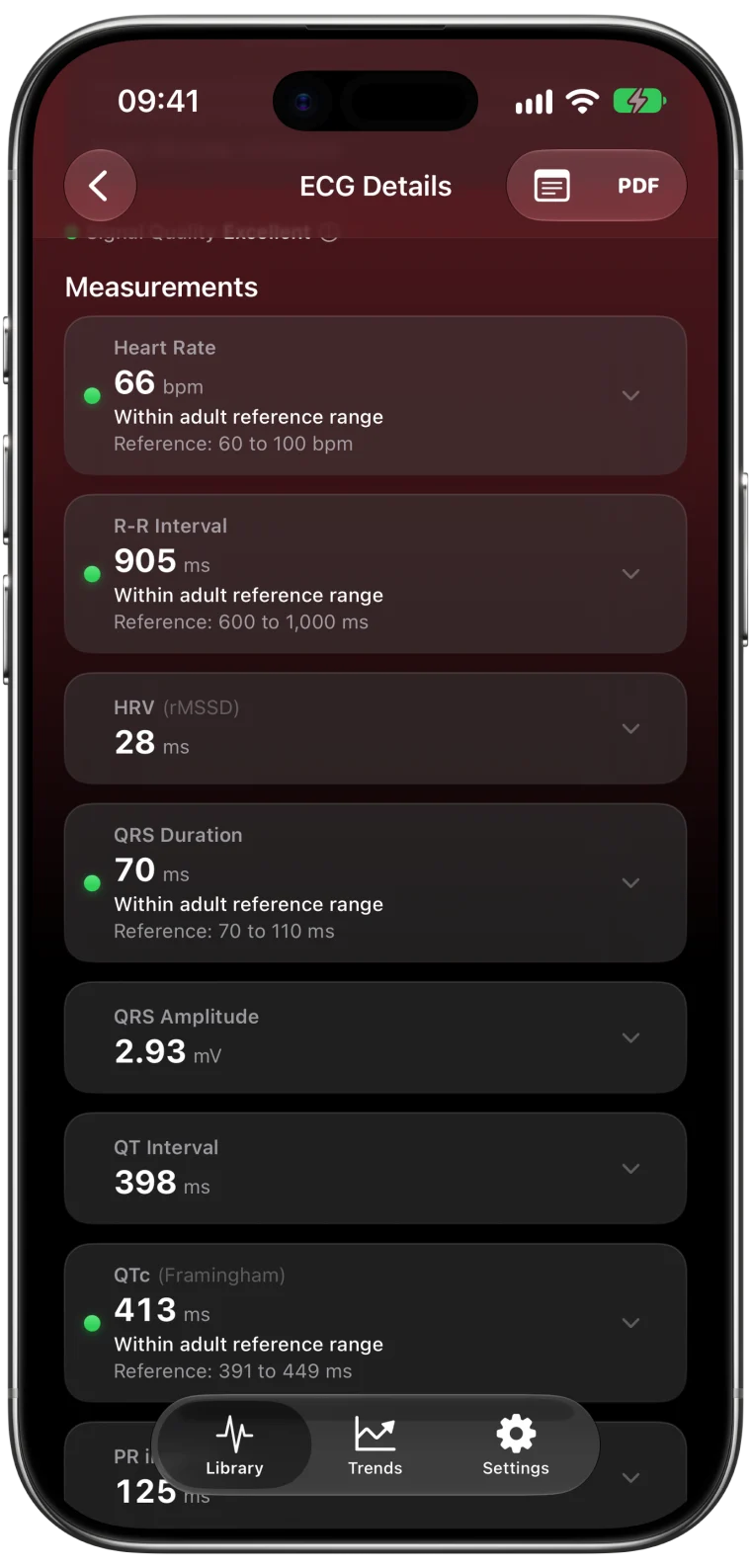
- Many interval estimates, such as QRS duration and often PR and QT, when the waves are clear
- Premature beats, which often stand out by their timing and shape
Studies have found that Apple Watch recordings can be used to classify AFib with good accuracy compared with clinical ECGs, within the limits described by Apple.2 Research has also studied measuring QT from watch recordings, with reasonable agreement in many cases but differences from 12-lead measurements.3
What a 12-lead ECG adds
Some heart problems only show up from certain angles, or need several leads to compare.
| Question | Apple Watch single lead | 12-lead ECG |
|---|---|---|
| Heart rate and regularity | Yes | Yes |
| AFib classification | Yes, within Apple's limits | Yes |
| Signs of a heart attack | No | Yes |
| Where an extra beat comes from | Limited | Better |
| Heart axis and chamber enlargement | No | Yes |
| Conduction blocks in detail | Limited | Yes |
| Continuous monitoring | No, 30 seconds | No, about 10 seconds |
Apple states that the ECG app cannot detect heart attacks, blood clots, strokes or many other conditions.4 That is not a flaw in the recording. It is simply what one lead can see.
Where the Watch has an advantage
The Watch is with you when something happens. A 12-lead ECG in a clinic captures about ten seconds on the day of your appointment, often when you feel fine. A watch recording can capture the moment you notice a flutter on the sofa at 11 pm. Many clinicians value that timing, as long as the limits of a single lead are clear.
For symptoms that come and go, doctors may also use longer monitors, such as a Holter or event monitor, which record for days or weeks.5
How to get the most from your single lead
- Record clean. Rest your arms and stay still. The clean ECG guide explains why.
- Record at the right moment. If you notice symptoms, record while they happen and add a note.
- Look closer. ECG Tracker+ shows the waveform on a calibrated grid with interval estimates and marks possible extra beats.
- Share it well. A detailed PDF with the full strip helps a clinician see what you saw.
Frequently asked questions
Is an Apple Watch ECG accurate?
It records a good-quality single-lead ECG and classifies AFib well within Apple's stated limits. It cannot replace a 12-lead ECG, because many conditions are only visible from other angles.
Can an Apple Watch ECG detect a heart attack?
No. Apple states that the ECG app cannot detect a heart attack. If you have chest pain, pressure or tightness, call emergency services immediately.
Do doctors accept Apple Watch ECGs?
Many clinicians look at them as useful context, especially when recorded during symptoms. They may still order a 12-lead ECG or longer monitoring to answer specific questions.
Which lead is the Apple Watch ECG?
It is similar to lead I, the view between the left and right arms.