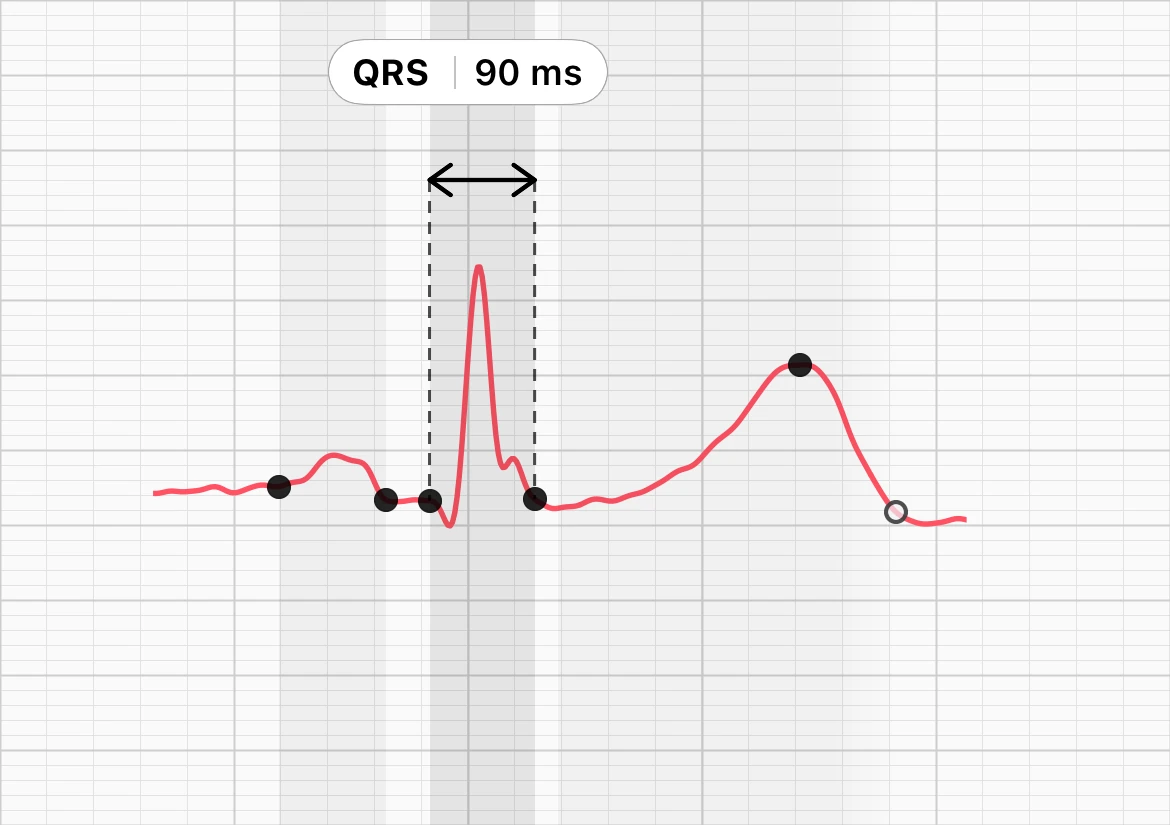
Some Apple Watch recordings show tall, sharp spikes. Others look small and flat, even from the same person on the same day. QRS amplitude puts a number on that height, and it is easy to read too much into it.
What QRS amplitude measures
QRS amplitude is the voltage difference between the highest and lowest points of the QRS complex, in millivolts. On standard ECG paper, 1 mV is 10 mm, or two large squares.
The height of the QRS reflects how much of the heart's electrical activity points toward the lead, and how well that signal reaches the electrodes. It is not a measure of how strongly the heart contracts.
QRS amplitude on a real beat
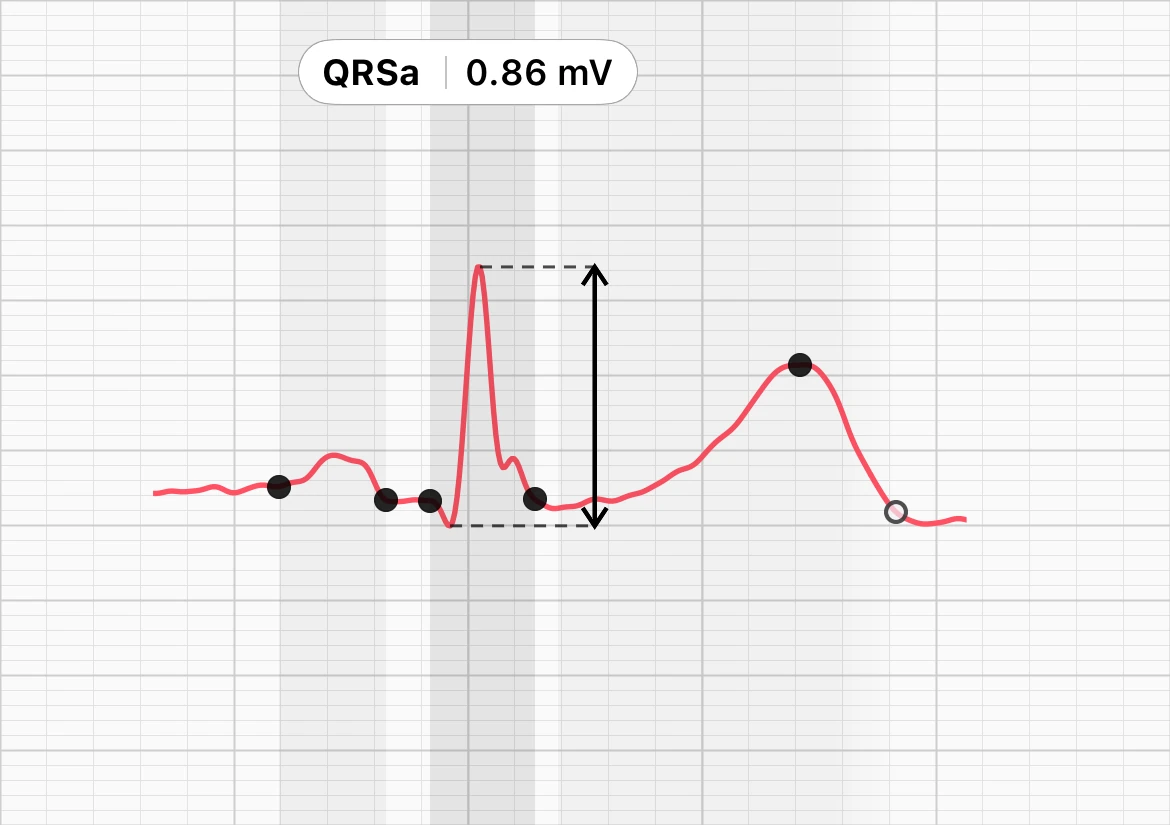
In the Beat Morphology view, ECG Tracker+ marks the lowest and highest points of the QRS on a representative beat and shows the height between them.
Why it varies so much
- Contact. How firmly your finger rests on the Digital Crown and how well the watch sits on your wrist change the signal.
- Wrist and arm position. Recording with the watch on the other wrist or with your arm in a different position changes the direction of the lead.
- Body build. Tissue between the heart and the skin weakens the signal.
- Anatomy. The direction of the heart's electrical axis differs between people.
Because of this, a single amplitude value means little on its own. Comparing recordings made the same way over time is more useful than comparing with someone else's value.
Very high or very low amplitude
On a 12-lead ECG, clinicians use amplitude as one of several clues. Very tall complexes in certain leads can go with a thickened heart wall, and very small complexes in all limb leads, under 0.5 mV, are called low voltage and have several possible causes.1 These criteria depend on multiple leads, so they cannot be applied to a single watch lead.
A low QRS amplitude on a watch recording does not mean a weak heart, and a high one does not mean a strong heart. If you have symptoms, talk to a clinician.
Frequently asked questions
What is a normal QRS amplitude on an Apple Watch?
There is no established range for a single watch lead. The value depends heavily on how the recording was made, so compare it with your own earlier recordings.
Why did my QRS amplitude drop?
The most common reasons are looser contact, a different arm position or a different wrist. Try recording the same way each time.
Does QRS amplitude show heart strength?
No. It measures the recorded electrical signal, not how strongly the heart pumps.