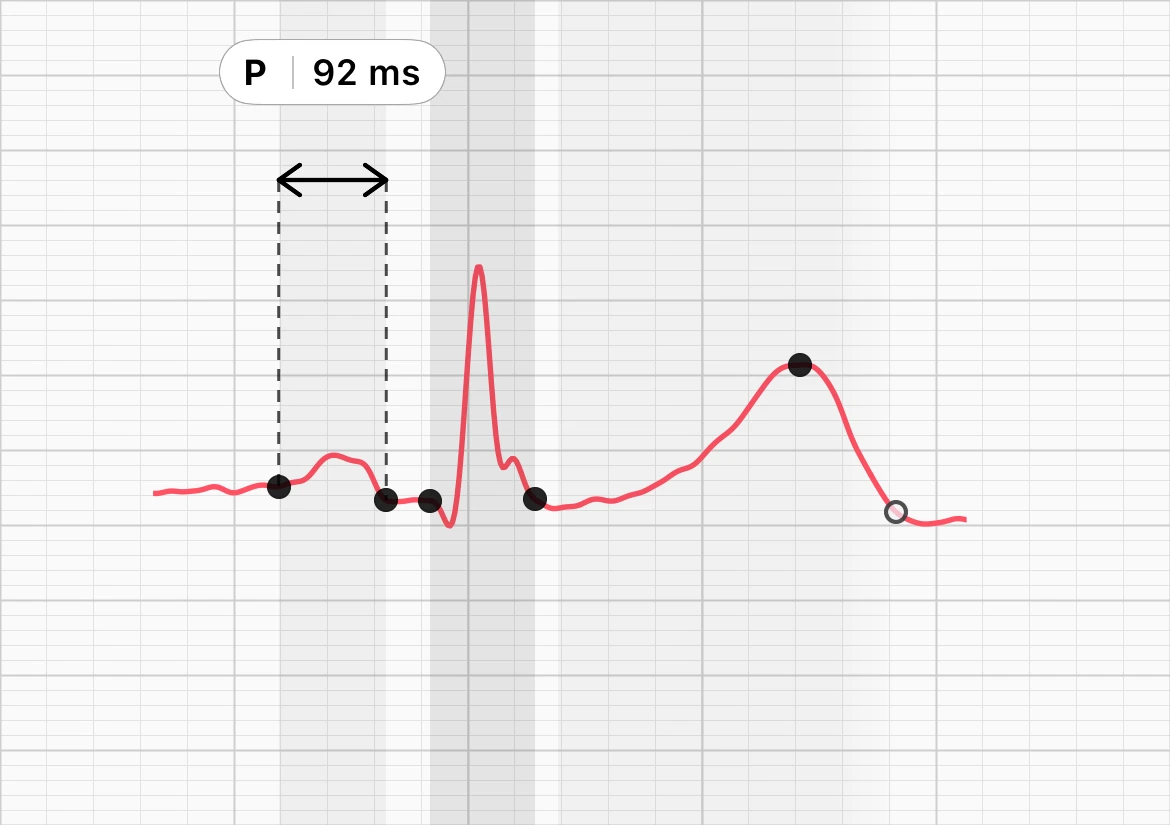
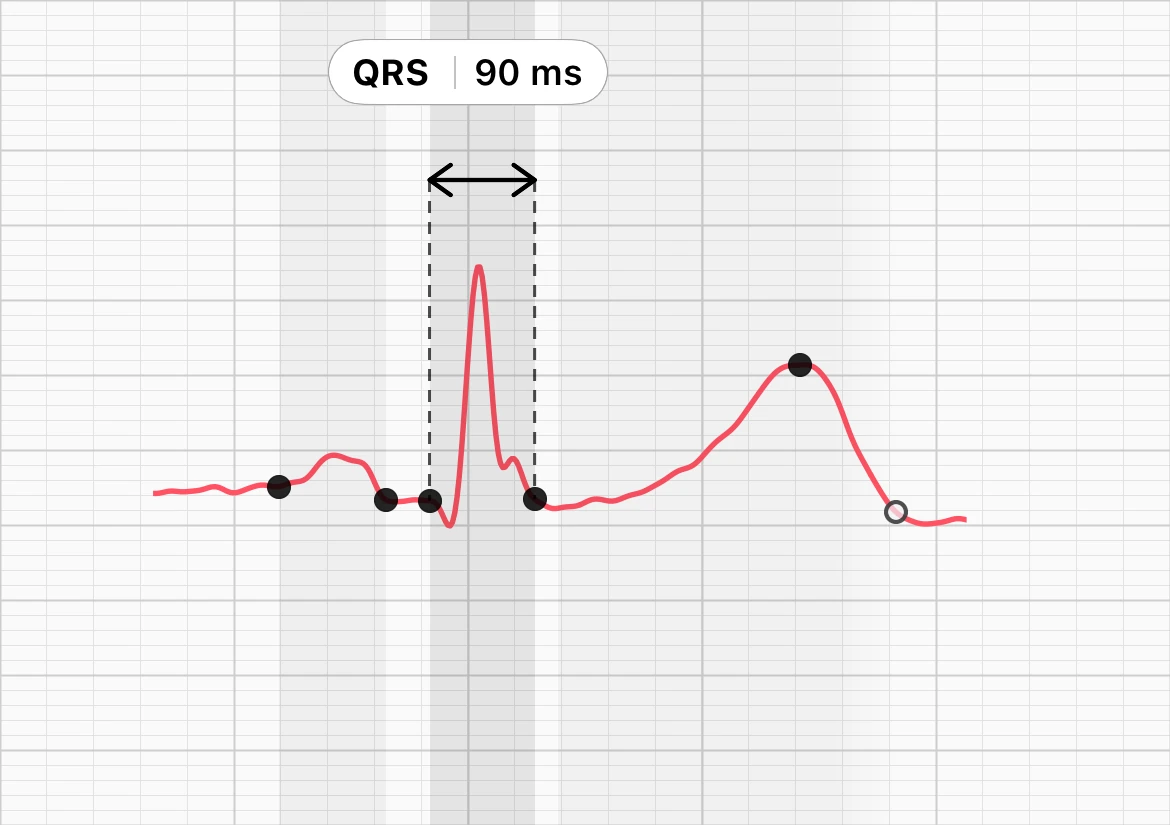
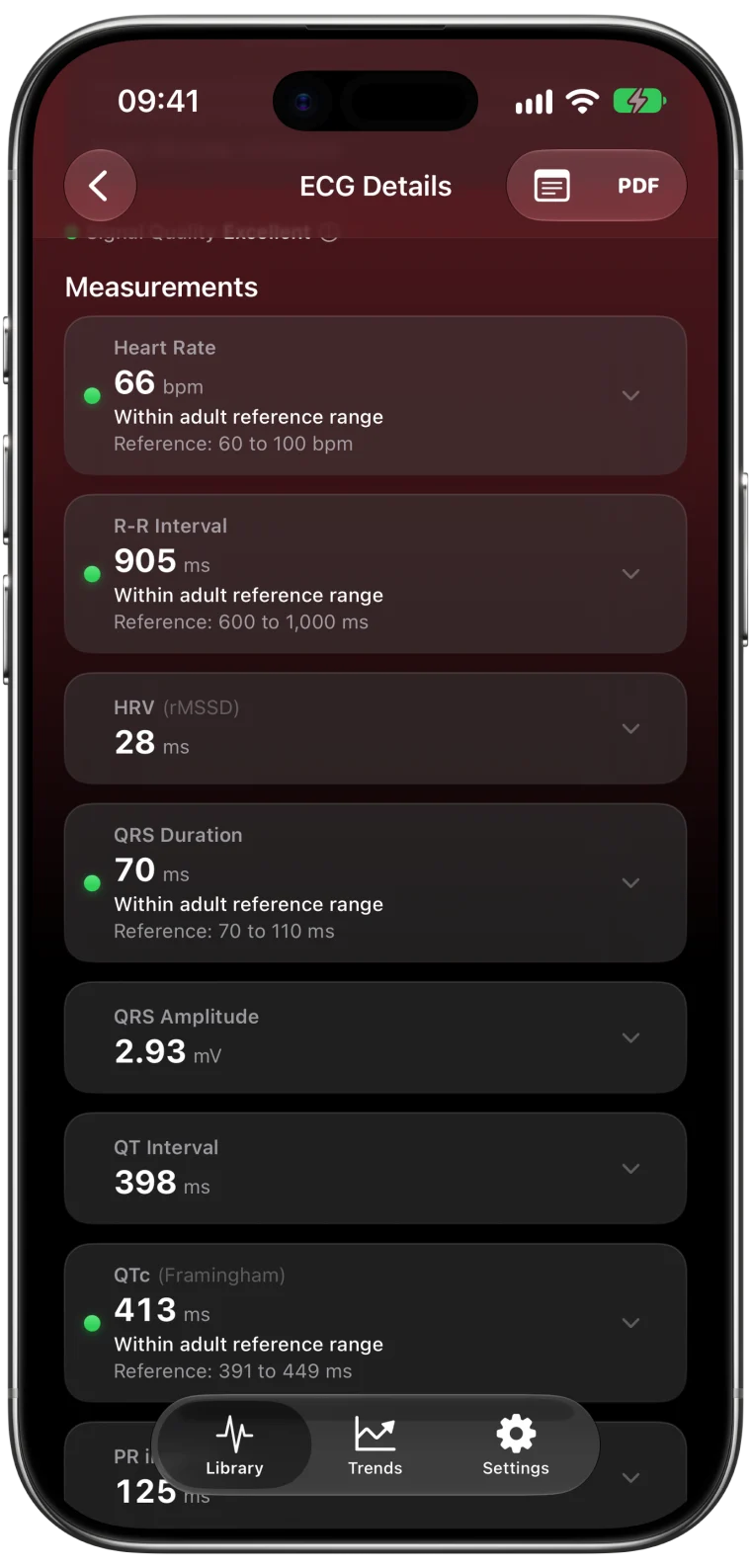
Between the small P wave and the tall QRS spike there is a short, flat pause. The PR interval measures that whole stretch, from the first sign of the P wave to the first sign of the QRS. It is the timing of the handoff between the upper and lower chambers.
What the PR interval measures
The PR interval covers activation of the upper chambers plus a brief delay at the AV node, the junction that passes the signal on to the lower chambers.1 That delay gives the atria time to finish pushing blood into the ventricles before they contract.
PR interval on a real beat
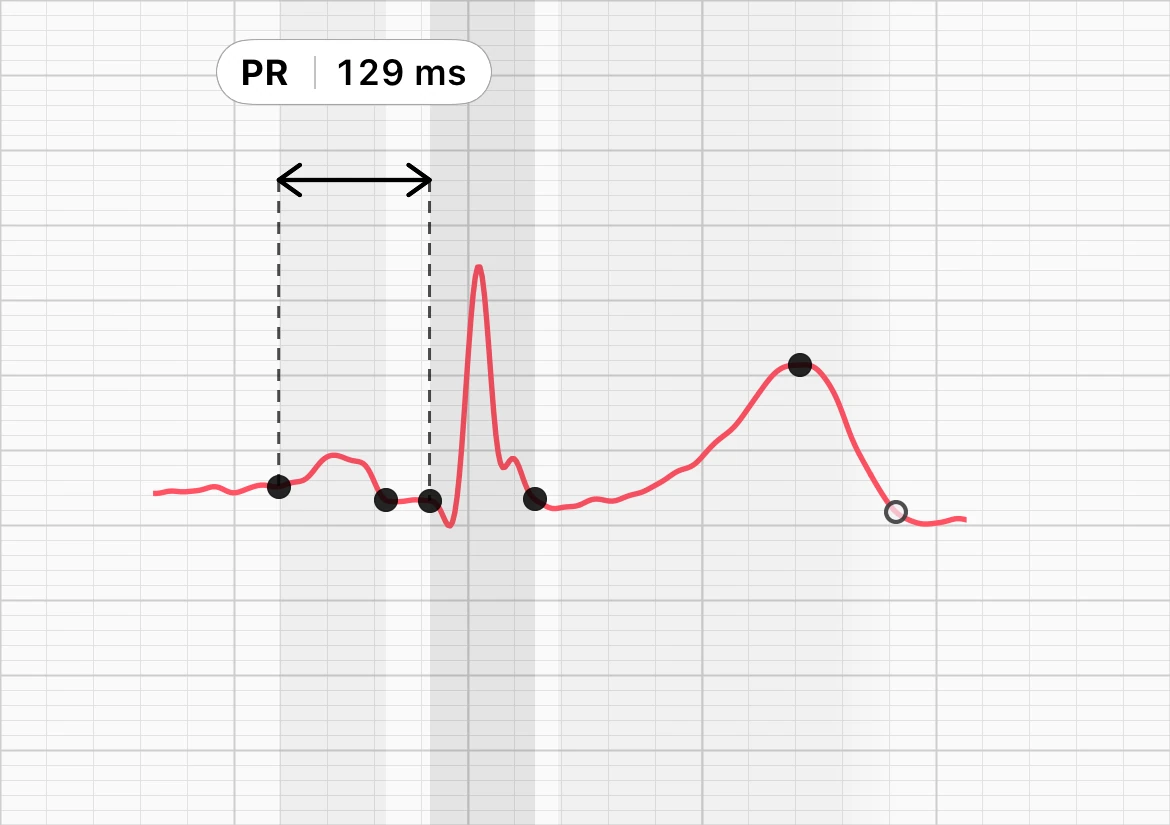
In the Beat Morphology view, ECG Tracker+ marks where the P wave starts and where the QRS starts on a representative beat, and shows the interval between them.
Typical range
| PR interval | What clinical references describe |
|---|---|
| About 120 to 200 ms | The typical adult range (some references use 100 ms as the lower limit)2 |
| More than 200 ms | First-degree AV block2 |
| Less than about 120 ms | A short PR, which can have several causes2 |
First-degree AV block is common and often causes no symptoms. It is still worth a clinician's view, because it can be linked to medicines, conduction changes or other conditions. A short PR can be normal, but in some people it goes with an extra conduction pathway. Only a clinician can tell which applies to you.
What changes the PR interval
- Heart rate. The PR usually shortens a little as heart rate rises.
- Medicines. Some medicines slow conduction through the AV node and lengthen the PR.
- Fitness. Well-trained athletes can have a longer PR at rest.
- Recording quality. If the P wave is hidden by noise, the PR cannot be measured and ECG Tracker+ leaves it unavailable.
Can an Apple Watch recording show the PR interval?
In a study of 43 healthy volunteers, PR measured by hand on Apple Watch recordings differed from lead I of a 12-lead ECG by about 5 ms on average, though individual recordings differed more.3 A clear watch recording often contains enough detail to estimate PR, and some do not.
A PR outside a typical range is not a diagnosis. If a measurement concerns you, a clinician can check it on a 12-lead ECG.
Frequently asked questions
What is a normal PR interval?
In adults, the PR interval is typically about 120 to 200 ms. Some references use 100 ms as the lower limit.
What does a PR interval over 200 ms mean?
It is called first-degree AV block, a slowing of conduction between the upper and lower chambers. It is often harmless, and a clinician can tell whether it needs attention.
Why is my PR interval unavailable?
The PR needs a clear P wave. On a single-lead recording the P wave is small and can be hidden by noise.