HRV has become one of the most talked-about health numbers, and Apple Watch already shows one in the Health app. So why would an ECG show a different HRV, and which one should you look at? The answer comes down to what is measured, how and for how long.
What HRV is
Your heart does not beat like a metronome. The time between beats changes constantly, lengthening as you breathe out and shortening as you breathe in. This variation is heart rate variability, and much of it reflects the influence of the vagus nerve, part of the nervous system that slows the heart at rest.1
rMSSD and SDNN
Two common ways to summarize HRV from normal beat-to-beat intervals:1
| Metric | What it measures | Best for |
|---|---|---|
| rMSSD | The size of changes between one beat and the next | Short recordings, beat-to-beat vagal influence |
| SDNN | How widely all the intervals spread around their average | Longer recordings, overall variability |
Both are expressed in milliseconds, and both use only normal beats. Extra beats and noise are excluded because they would distort the result.
HRV on a real recording
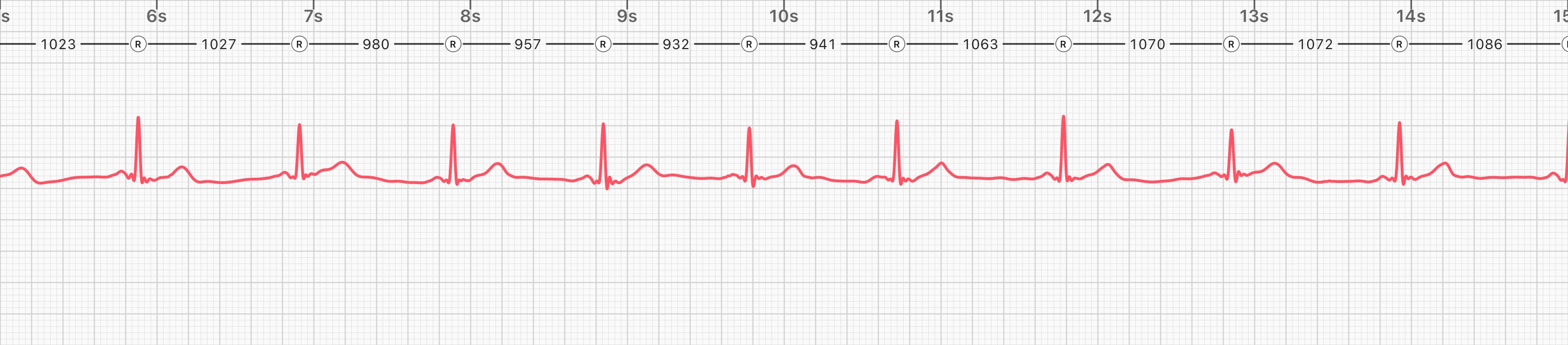
This is a real 30-second Apple Watch ECG, analyzed by ECG Tracker+ with the same analysis it runs on your recordings. The numbers above the waveform are the R-R intervals in milliseconds.
In these ten seconds the intervals fall from about 1,027 ms to 932 ms and then rise again to 1,086 ms. A slow rise and fall like this is typical of the way breathing changes heart rate. Across the whole recording, at an average heart rate of about 61 bpm, the app calculated an rMSSD of 43 ms and an SDNN of 48 ms.
Why Apple Health's HRV is different
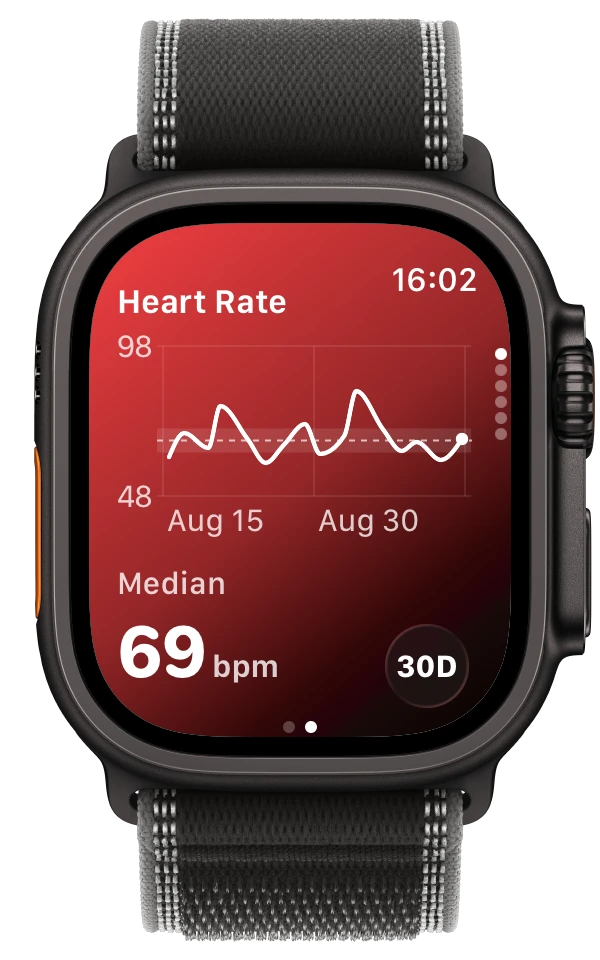
Apple Watch calculates the HRV you see in Apple Health as SDNN, using the optical heart sensor on the back of the Watch while you are still. It takes these measurements periodically through the day and during Breathe sessions.2
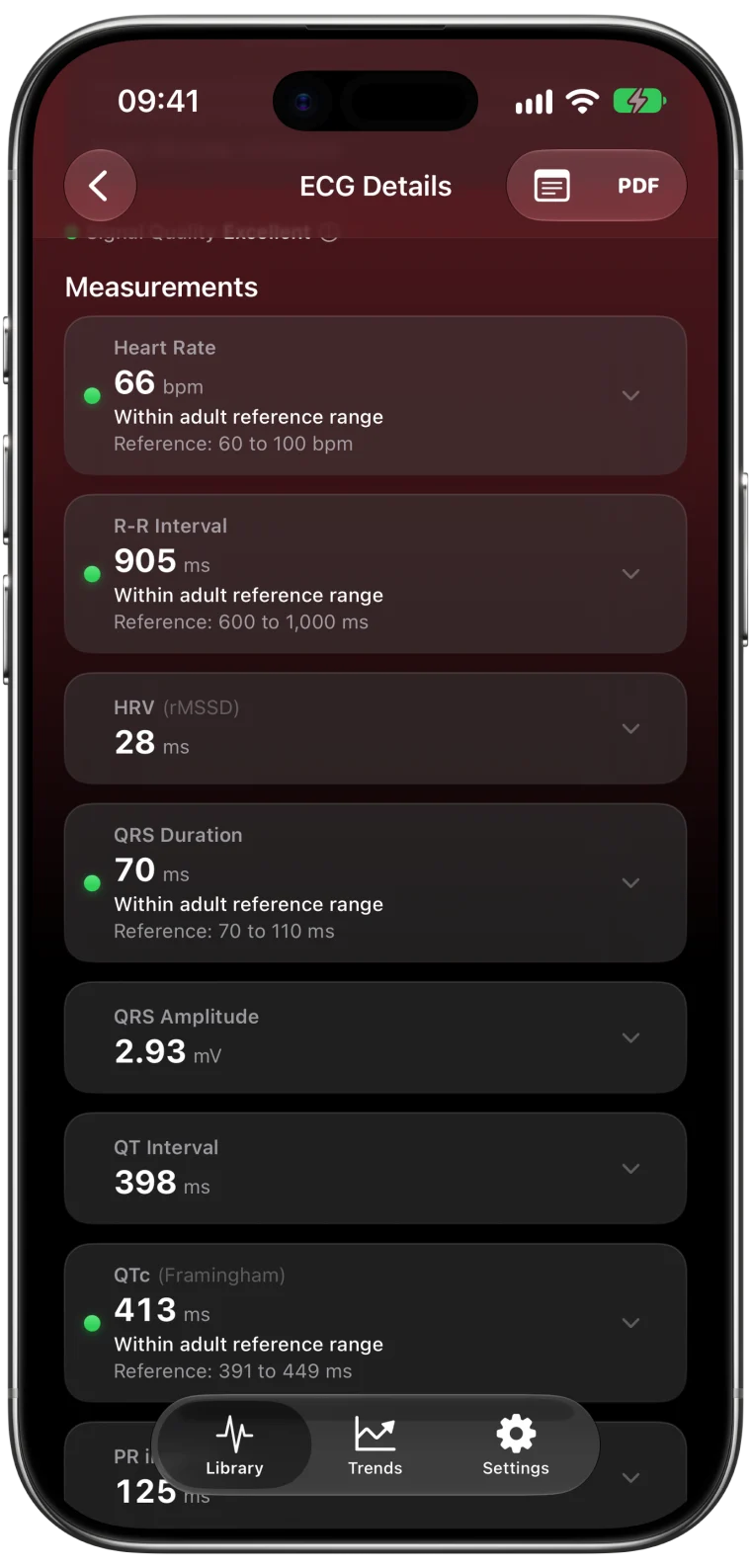
An ECG measures each heartbeat electrically, with precise timing for every R peak. ECG Tracker+ uses those intervals from each 30-second recording to calculate rMSSD and SDNN.
| Apple Health HRV | HRV from your ECG in ECG Tracker+ | |
|---|---|---|
| Sensor | Optical (PPG) | Electrical (ECG) |
| Metric | SDNN | rMSSD and SDNN |
| When | Periodically in the background | Each time you record an ECG |
| Length | Short background measurement | 30 seconds |
Because they use different sensors, metrics and moments, the two values are not interchangeable. One is not a check on the other.
What 30 seconds can tell you
Standard HRV measurements use 5 minutes for short-term analysis and 24 hours for long-term analysis. Anything shorter is called ultra-short, and researchers treat ultra-short values as rough proxies that are not interchangeable with standard recordings.1
Of the common metrics, rMSSD holds up best in very short recordings. One large study found that rMSSD from segments as short as 10 seconds already approximated longer recordings, while SDNN needed about 30 seconds, or several 10-second segments, to do the same.3 That study used intervals from blood pressure recordings rather than ECGs, so it supports the principle rather than any specific device.
The practical takeaway: an rMSSD from a 30-second ECG is a real measurement of those 30 seconds. It is most useful for comparing your own recordings made under similar conditions, and it should not be compared directly with 5-minute or 24-hour values from a clinic or another device.
What a "good" HRV is
There is no single normal HRV. It is typically higher in younger people and falls with age.1 It also differs a lot from one healthy person to another. Breathing, posture, time of day, recent exercise, sleep, alcohol, caffeine, illness and stress all move it.
That is why your own history matters more than any chart of averages. A value that is typical for you, measured the same way, is the best reference.
How to track HRV fairly
- Record at a similar time of day, ideally in the morning at rest.
- Sit for a few minutes before recording and breathe normally.
- Keep posture and arm position the same.
- Note anything unusual, such as poor sleep or a late workout.
- Treat recordings with extra beats or noise as less comparable.
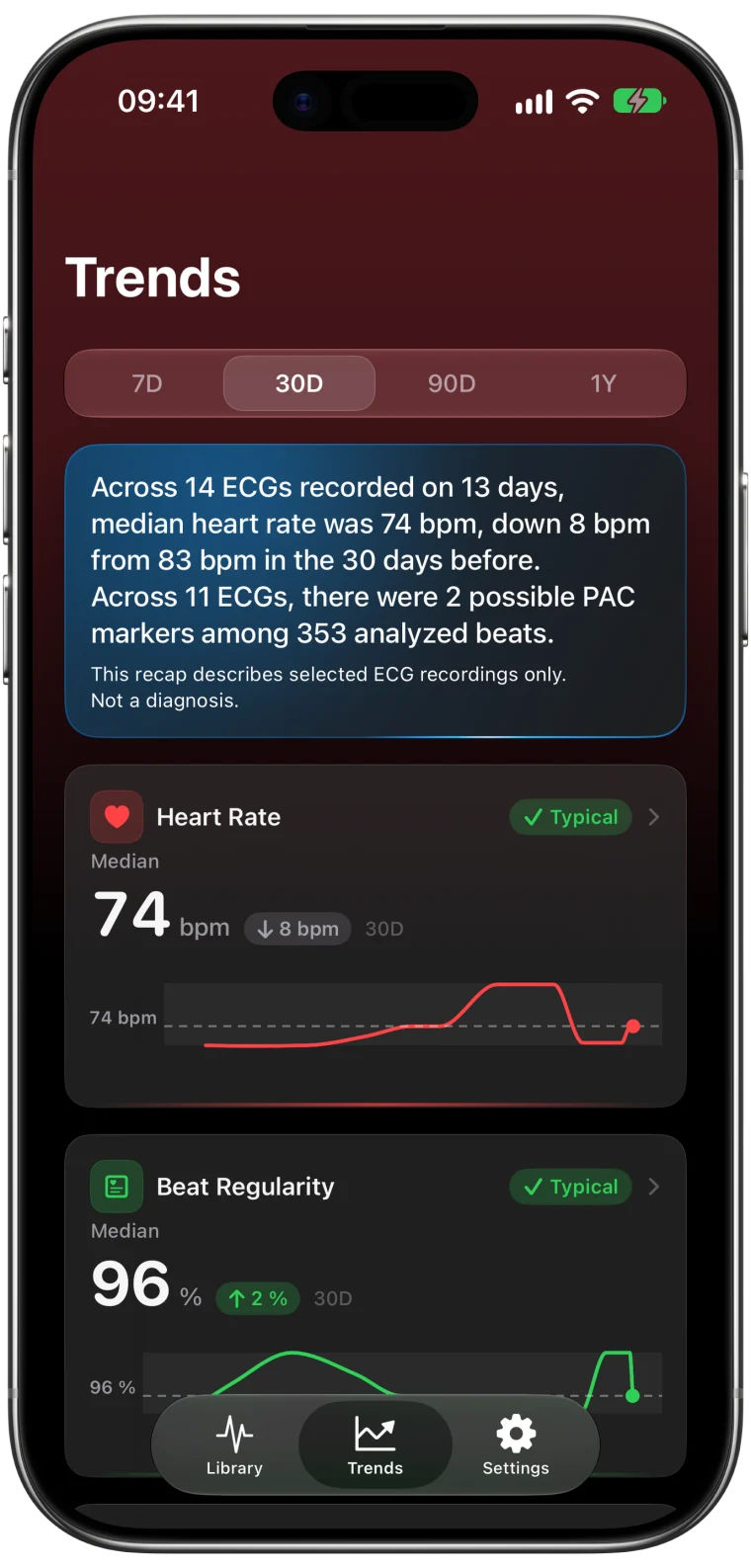
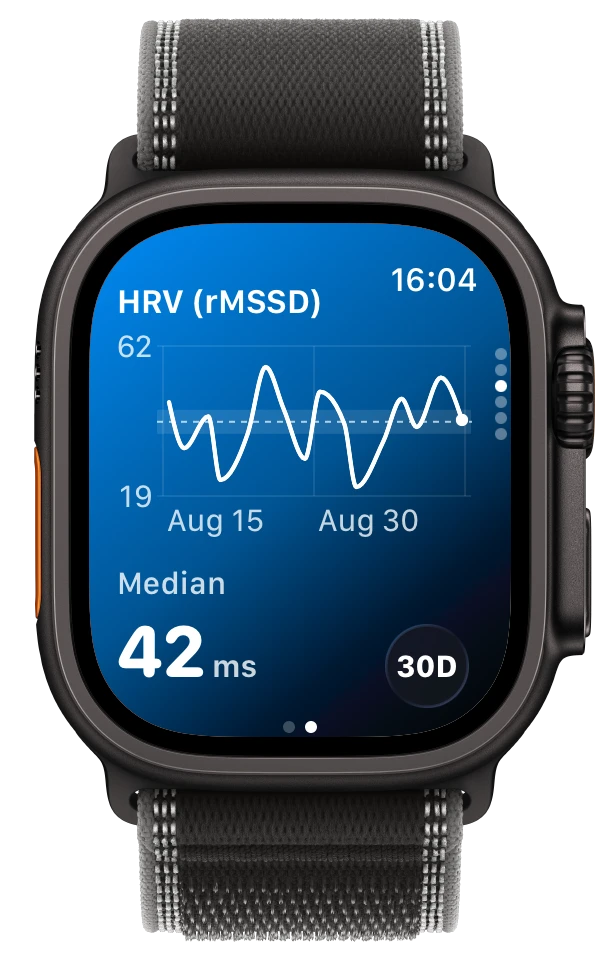
In ECG Tracker+, the HRV card in Trends shows your median for the period and how it changed. The Apple Watch app shows an HRV trend on your wrist too.
A lower or higher HRV on its own does not diagnose anything. If you notice changes along with symptoms, talk to a clinician.
Frequently asked questions
Does Apple Watch use rMSSD or SDNN?
Apple Health reports HRV as SDNN, measured with the optical sensor. ECG Tracker+ calculates rMSSD and SDNN from your ECG recordings.
Why is my ECG HRV different from Apple Health HRV?
They use different sensors, different metrics and different moments. A 30-second ECG rMSSD and a background optical SDNN are not interchangeable, so different numbers are expected.
Is a 30-second HRV accurate?
It accurately describes those 30 seconds, and rMSSD holds up reasonably well in short recordings. It is an ultra-short snapshot, best used to compare your own recordings made the same way.
What is a normal rMSSD?
There is no single normal value. rMSSD varies widely between healthy people and falls with age. Your own recordings under similar conditions are the most useful reference.