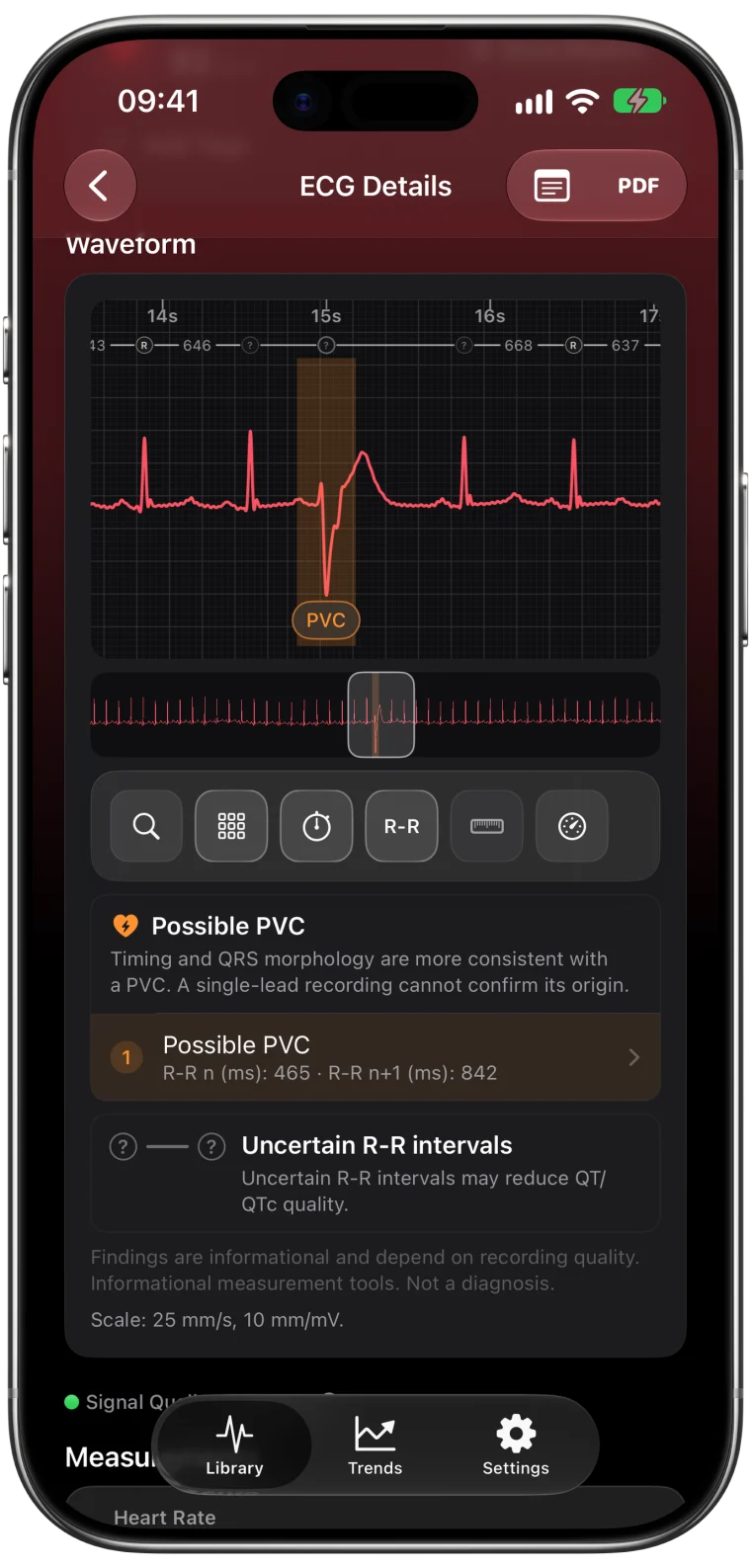
Sinus Rhythm is the result you hope to see, and most of the time it is the one you get. Still, many people wonder what exactly it confirms, and why an app might mark a possible extra beat on a recording that Apple called Sinus Rhythm. Both questions have clear answers.
What "sinus" refers to
Each normal heartbeat starts in the sinus node, a small cluster of cells in the right upper chamber that acts as the heart's natural pacemaker. From there the signal spreads through the upper chambers, pauses briefly at the AV node, then races through the lower chambers.1
On an ECG, that sequence looks like a small P wave, followed by a sharp QRS complex, followed by a broader T wave, repeating at a steady pace. When this pattern is regular and the heart rate is between 50 and 100 bpm, Apple's ECG app classifies the recording as Sinus Rhythm.2
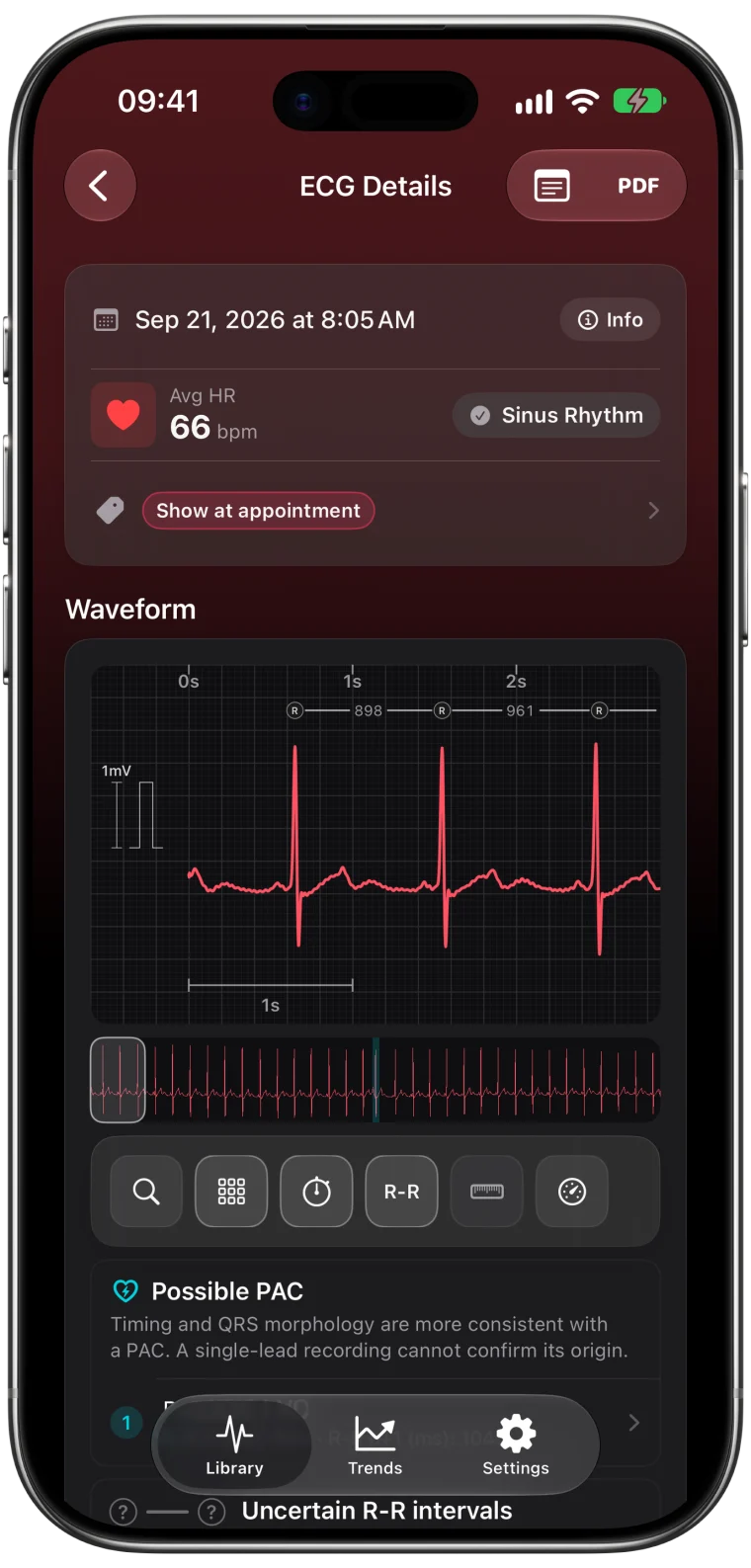
Sinus rhythm on a real recording
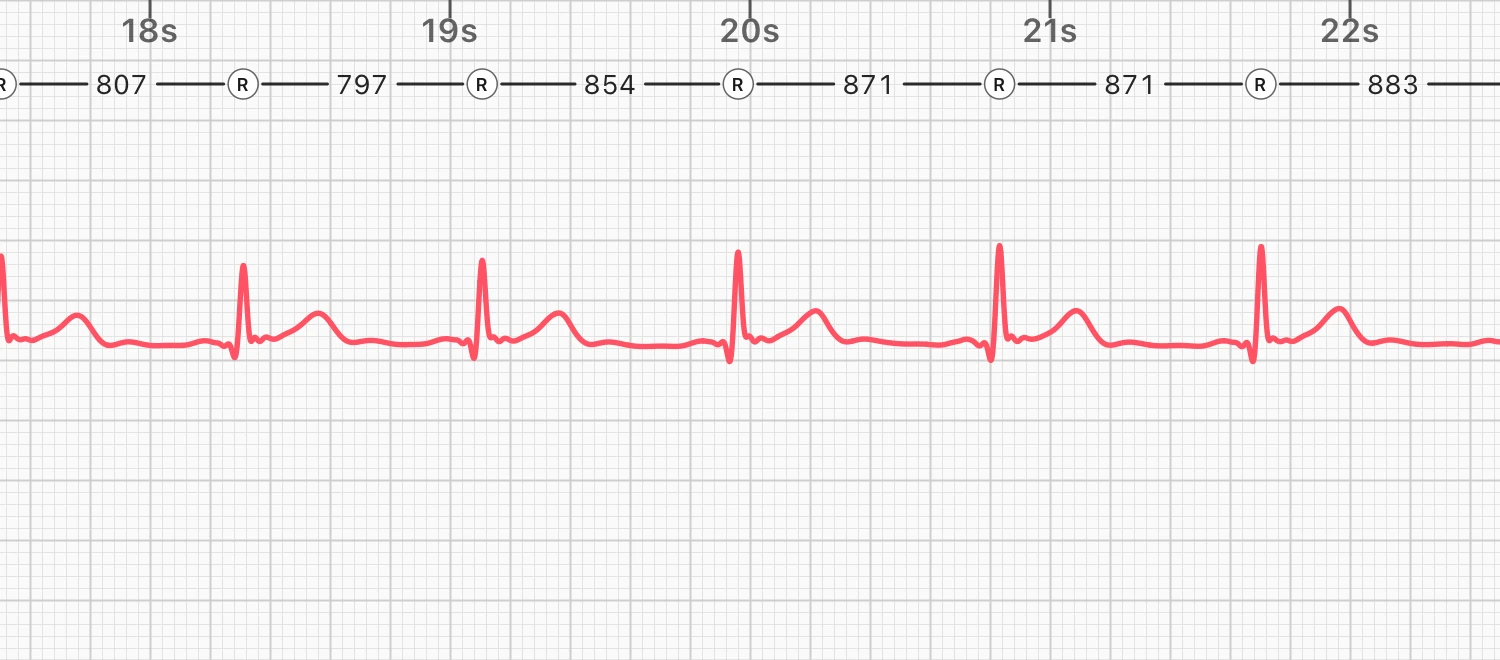
This is a real 30-second Apple Watch ECG, analyzed by ECG Tracker+ with the same analysis it runs on your recordings. Each beat follows the same sequence: a small P wave, a narrow QRS spike and a rounded T wave.
The spacing between beats is nearly even. In these five seconds the R-R intervals range from 797 to 883 ms, a heart rate of about 73 bpm, well inside the 50 to 100 bpm range Apple uses for Sinus Rhythm. The app marked no extra beats in the 30 seconds.
The small differences between the intervals are normal. The next sections explain what a result like this does and does not tell you.
What Sinus Rhythm tells you
- Your heart rate during the recording was between 50 and 100 bpm.
- The upper and lower chambers were beating in sync.
- The overall pattern was uniform enough to classify.
What it does not tell you
Apple is clear that a Sinus Rhythm result applies only to that recording and does not mean you are healthy.2
- It is a snapshot. Thirty seconds cannot show what your rhythm does during the rest of the day.
- Extra beats can still appear. A few premature beats within an otherwise sinus recording may not change the overall classification. ECG Tracker+ may mark such a beat as a possible PAC or PVC for you to review.
- One lead has blind spots. Many conditions, including heart attacks, cannot be seen on a single-lead recording.2
- Intervals are separate. A sinus classification does not describe your PR, QRS or QT intervals. Those are separate measurements.
Why an app can mark a possible extra beat on a Sinus Rhythm ECG
Apple's classification looks at the recording as a whole. A detailed view looks at each beat. If most beats are regular and one arrives early, the recording can reasonably be called Sinus Rhythm overall while a single beat still stands out.
ECG Tracker+ marks that beat as a possible PAC or PVC and shows the R-R intervals around it. It is a cue to look, not a confirmed finding. The PAC and PVC guide shows what these beats look like.
Sinus rhythm variations you might notice
The time between beats in sinus rhythm is rarely perfectly equal. In many healthy people, especially younger people, heart rate rises slightly when breathing in and slows when breathing out. This is called sinus arrhythmia and is a normal variation.3 It shows up as gently varying R-R intervals.
Heart rates just outside the range have their own labels. Below 50 bpm, Apple reports Low Heart Rate. Above the upper limit, it reports High Heart Rate. The results guide covers each one.
If you feel unwell, talk to a doctor even when your Watch says Sinus Rhythm. For chest pain, fainting or severe shortness of breath, call emergency services.
Frequently asked questions
Does Sinus Rhythm mean my heart is normal?
It means your heart beat in a uniform pattern between 50 and 100 bpm during that recording. Apple states that it does not mean you are healthy, because a 30-second single-lead ECG cannot show every condition.
Can I have PVCs or PACs with a Sinus Rhythm result?
Yes. Occasional premature beats can appear within an otherwise sinus recording. A detailed view like ECG Tracker+ may mark them as possible extra beats for review.
Why is my Sinus Rhythm heart rate different from my resting heart rate?
The ECG heart rate is measured during those 30 seconds, while resting heart rate in Apple Health is estimated from optical readings over the day. They measure different moments.