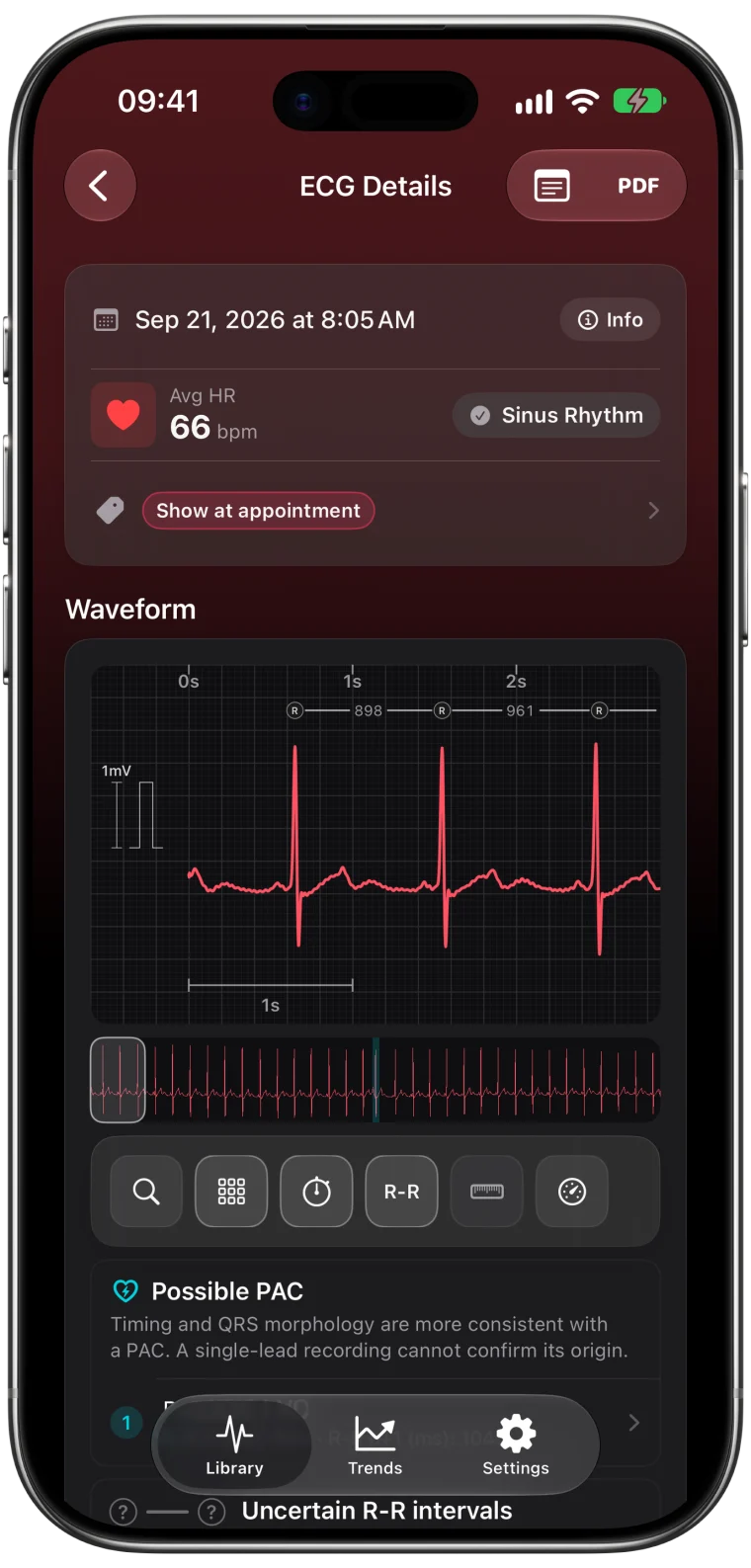
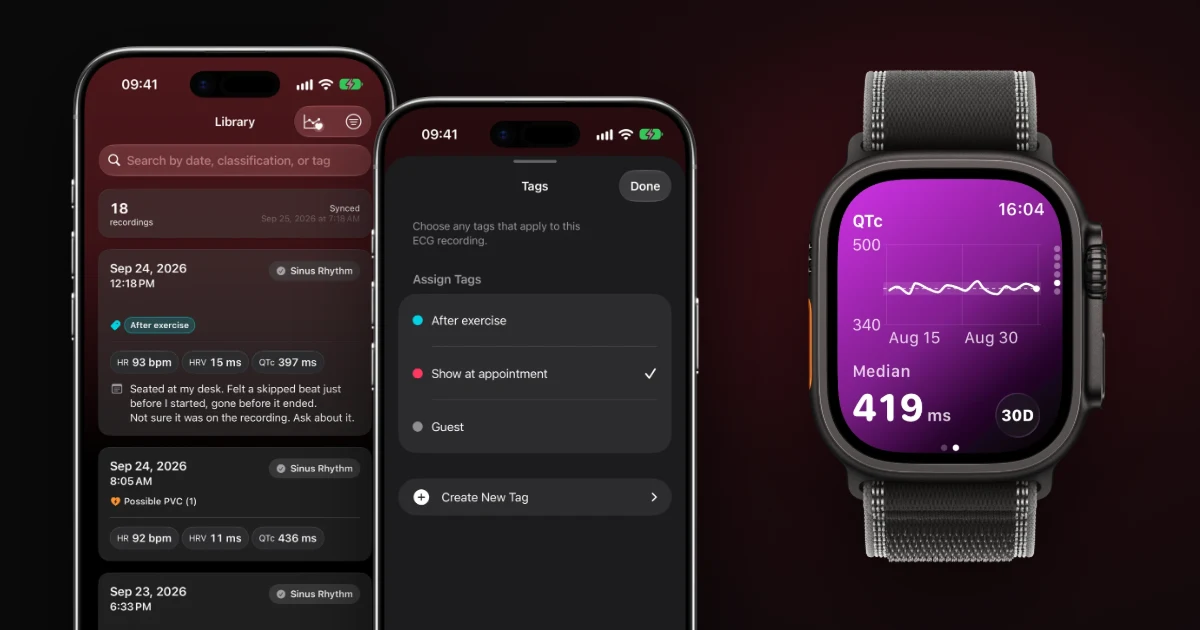
A skipped beat, a thump, a flutter that comes and goes. Premature beats are one of the most common reasons people take an ECG with their Apple Watch. Then the result says Sinus Rhythm, or Inconclusive, and nothing about the beat they felt. The beat may well be in the recording. You just need to know where to look.
What PACs and PVCs are
Premature beats are extra beats that come earlier than the next regular beat would.
- A PAC, premature atrial contraction, starts in one of the upper chambers, the atria.1 The PAC guide shows one on a real recording.
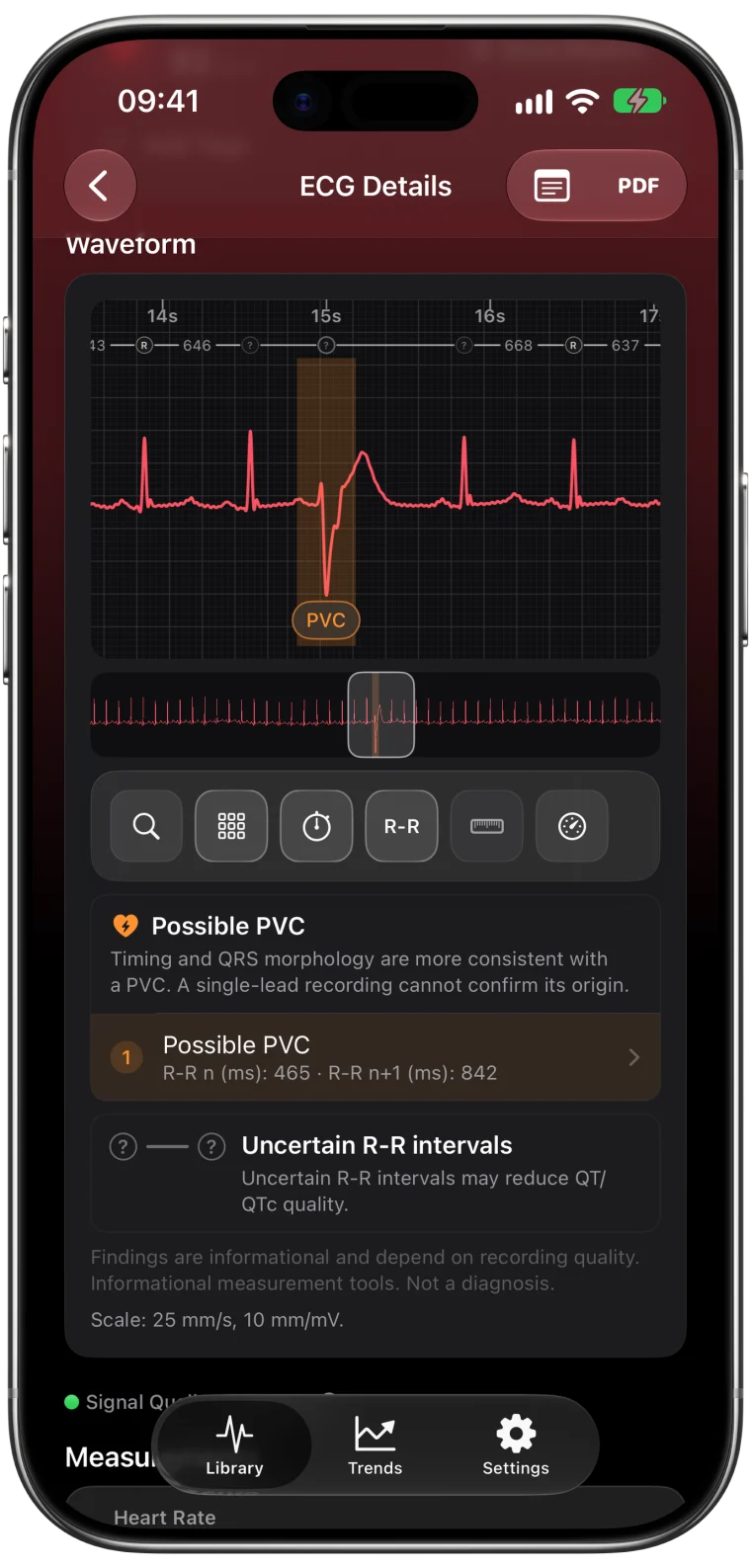
- A PVC, premature ventricular contraction, starts in one of the lower chambers, the ventricles.2 The PVC guide shows one on a real recording.
Both are very common. PVCs occur in up to three quarters of people at some point, and most are not dangerous.2 PACs are common at all ages. In a study of adults aged 50 and older who wore a 24-hour monitor, only about 1% had no PACs at all.3
Many people never feel them. Others notice a flutter, a pause or a strong beat. Possible triggers include caffeine, alcohol, tobacco, stress and tiredness.1 Stress and anxiety can also set off PVCs, and so can low potassium or magnesium.2
What they look like on the waveform
Every premature beat arrives early, which breaks the steady spacing between beats. After it there is often a longer pause before the next regular beat.
A possible PVC often looks different from the surrounding beats. The QRS may be wider and shaped differently, and there is usually no P wave before it. The pause after it is often long.
A possible PAC usually has a narrow QRS that looks like the others, because the signal still travels through the lower chambers normally. It arrives early, sometimes with a P wave that looks different or is hidden in the previous T wave.
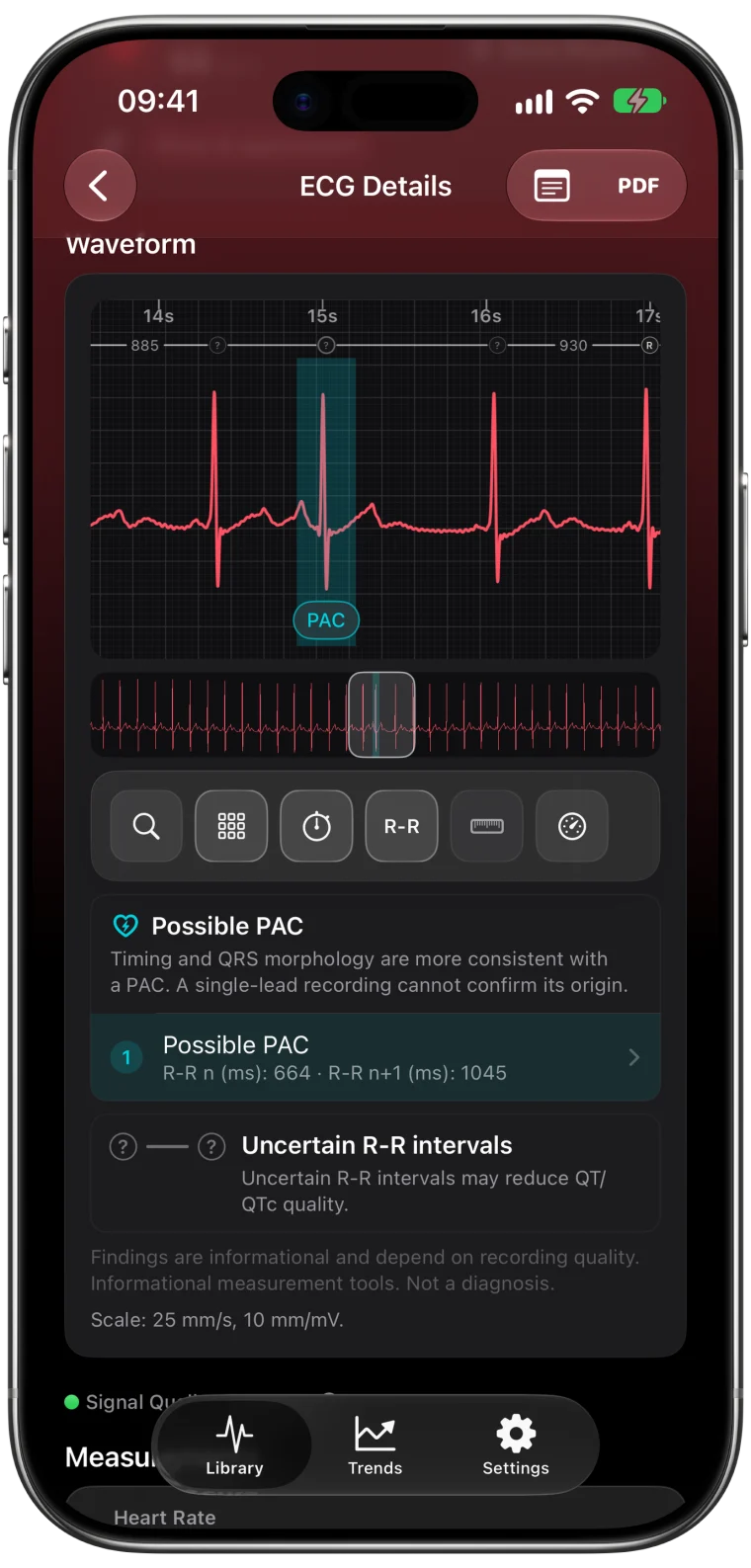
In ECG Tracker+, tapping a finding focuses the waveform on the marked beat and shows the R-R interval before and after it. Comparing those two gaps is often the clearest clue that a beat was premature.
Why the app says "possible"
Telling a PAC from a PVC depends on details like the presence and shape of the P wave and the width of the QRS. On a single lead, those details are not always clear. Noise, movement and other rhythms can also resemble a premature beat.
Medical experts note that consumer ECG devices cannot currently classify PACs and PVCs the way a clinical assessment does.4 That is why ECG Tracker+ calls them possible PACs and PVCs. A marker is a cue to look closer and, if it matters to you, to show a clinician. It is not a confirmed finding.
What 30 seconds cannot tell you
A 30-second recording is a tiny sample of your day. How many premature beats you catch depends heavily on how long you record. In one review, at least one PVC was found in under 1% of people on a 48-second ECG, but in 69% of healthy adults on a 24-hour monitor.5
When clinicians want to know how often premature beats happen, the so-called burden, they use a Holter or patch monitor that records for a day or more. A burden above about 10% of all beats is where they begin to consider effects on the heart muscle.5 No 30-second strip can measure that, and no strip without a marker can rule out premature beats.
Using your recordings well
- Record during symptoms. If you feel a flutter, record while it is happening. That is the recording most likely to catch it.
- Add a note. Write what you felt and whether it overlapped the recording.
- Tag the recordings. Group them for your appointment, as the organizing guide describes.
- Watch the ectopy rate in Trends. It shows how often possible extra beats were marked across your recordings, which is context, not a burden measurement.
- Share the full strip. A PDF with the whole waveform lets a clinician judge the beat for themselves.
Frequently asked questions
Can Apple Watch detect PVCs?
Apple's ECG app does not label PVCs, but they often appear on the waveform. ECG Tracker+ marks possible PVCs and PACs on your Apple Watch recordings for review.
Why did my Apple Watch say Sinus Rhythm when I felt a skipped beat?
A few premature beats may not change the overall classification, or the beat may have happened outside the 30 seconds. Look at the waveform for an early beat followed by a longer pause.
Are PVCs dangerous?
Most PVCs are not dangerous, but very frequent PVCs over months or years can weaken the heart muscle. A clinician can assess them with longer monitoring if needed.
Can I tell a PAC from a PVC on my Apple Watch ECG?
Sometimes. PVCs often look wider and different from other beats, while PACs usually look similar but arrive early. On a single lead, the difference cannot always be confirmed, which is why markers are labeled possible.
Sources
- Cleveland Clinic: Premature atrial contractions
- Cleveland Clinic: Premature ventricular contractions
- Conen D et al.: Premature atrial contractions in the general population, Circulation 2012
- ISHNE, HRS, EHRA and APHRS: Digital health collaborative statement on mobile ECG devices, 2021
- Premature ventricular contraction burden and monitoring duration, review, 2023