Two ordinary beats, then one that comes too soon. Then two ordinary beats again. That steady three-beat rhythm is trigeminy. It is a close relative of bigeminy, and like bigeminy it describes a pattern of early beats rather than a disease. Here is what it looks like on a real single-lead recording.
What trigeminy is
In trigeminy, every third beat is a premature beat.1
A real example

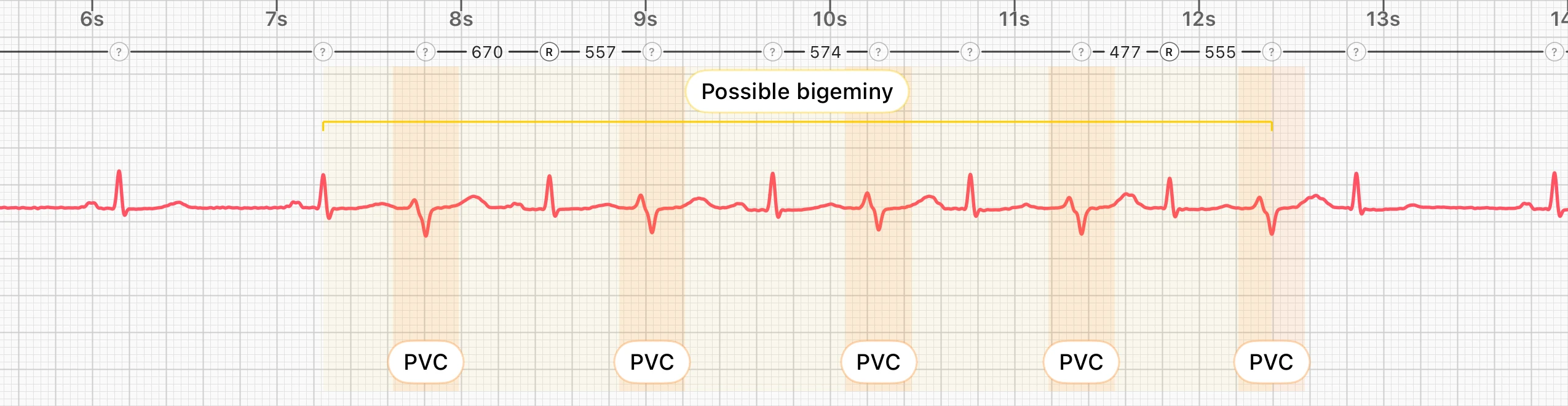
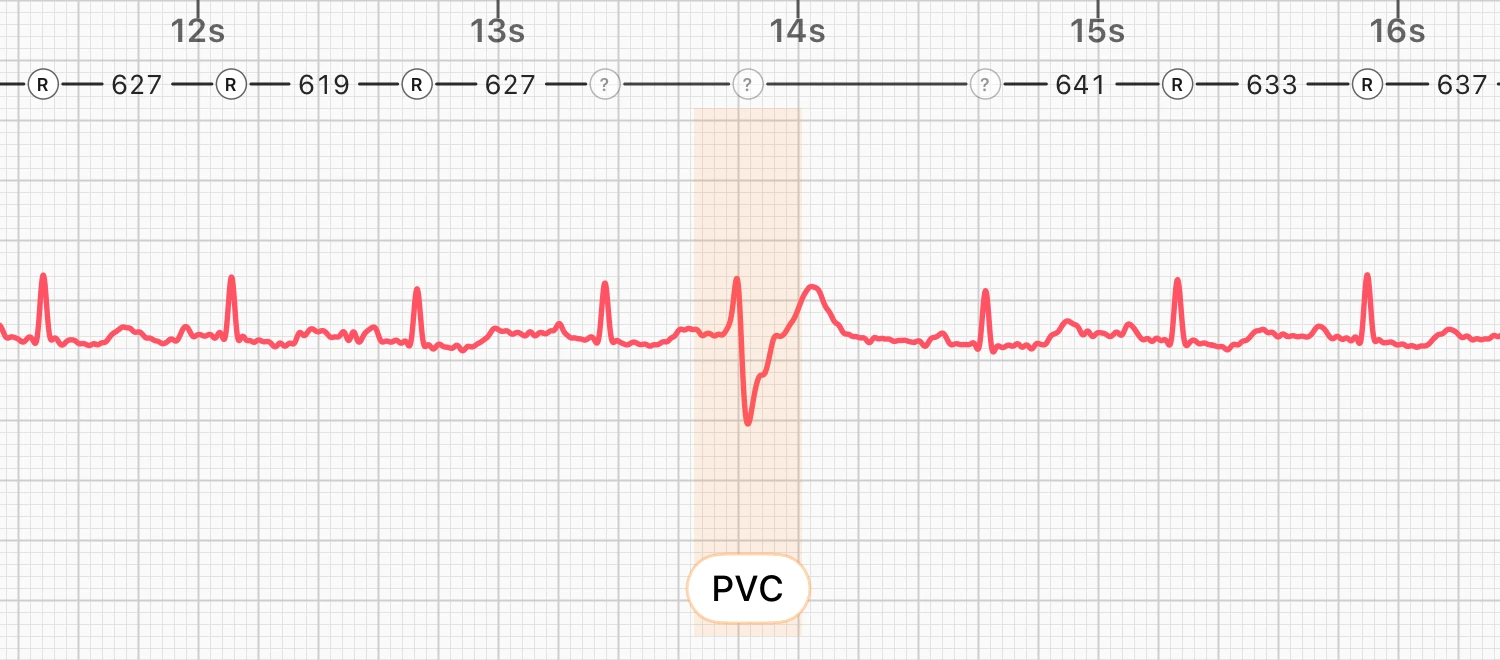
This is a real recording in lead I, the lead closest to what an Apple Watch records, with every beat labeled by experts. The expert annotation labels every third beat in the pattern as a PVC. Scroll sideways to follow it.
ECG Tracker+ marked possible trigeminy from about 2.4 to 24.7 seconds, a stretch with 11 early beats, each after two normal beats. Each early beat came about 0.46 to 0.59 seconds after the beat before it, followed by a longer gap of about 0.76 to 0.96 seconds.
Look closely and you will see that on this single lead, not every early beat looks clearly wider than the normal ones. That is one reason a single lead cannot always tell where an early beat started.
How to recognize it
- A repeating three-beat rhythm. Two evenly spaced beats, then a short gap to an early beat, then a longer gap. The pattern repeats like a waltz.
- The early beat is the odd one out. In ventricular trigeminy the early beat is often wider or shaped differently from the two normal beats before it. In atrial trigeminy it usually looks like its neighbors.
- It keeps going. A single early beat is just that. Trigeminy is the early beat returning after every two normal beats.
How ECG Tracker+ shows it
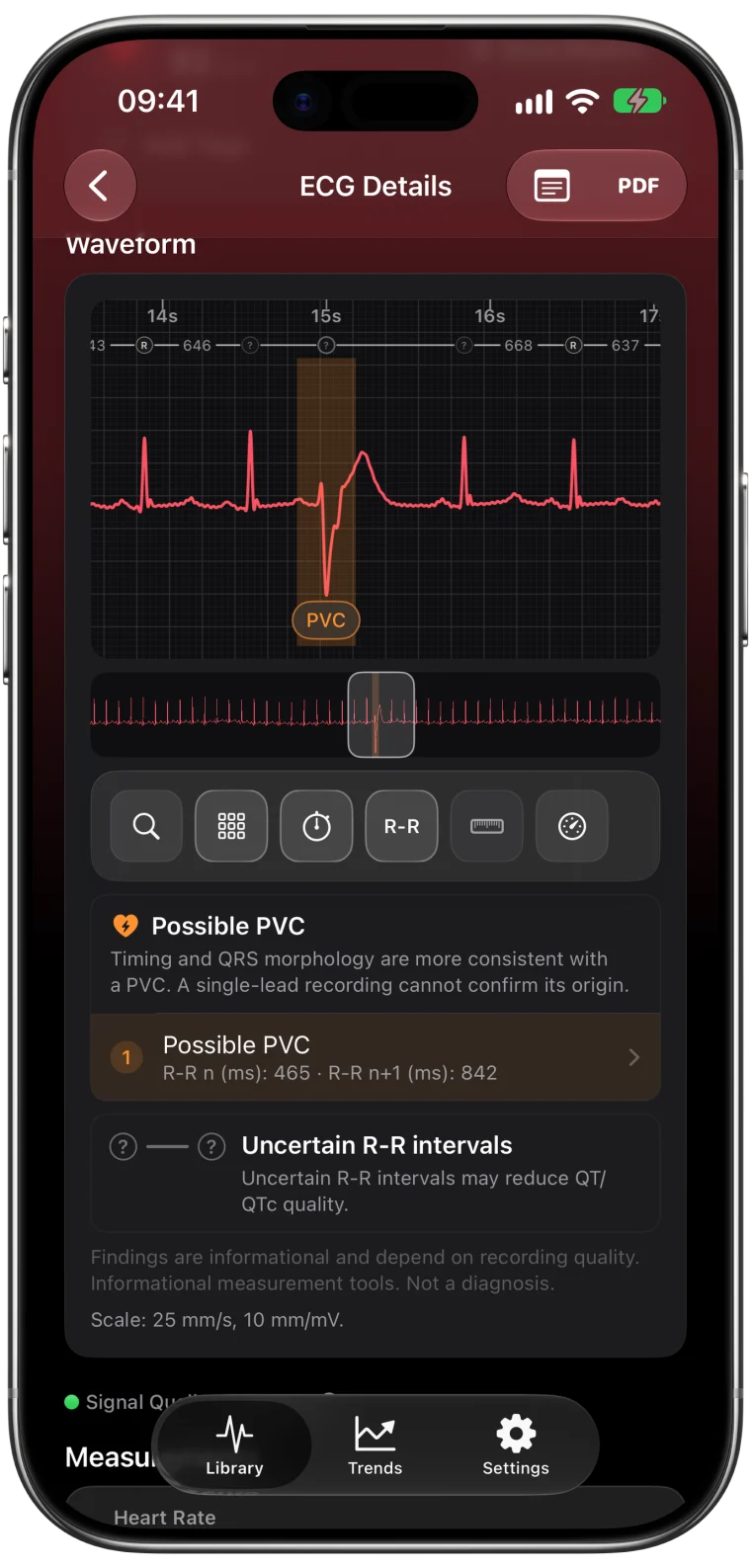
ECG Tracker+ looks for early beats that return after every two normal beats. When the pattern continues for at least four cycles in a row, it marks possible trigeminy and shades the stretch on the waveform where it was found, so you can see where it starts and ends.
Why the app says possible
On a single lead, the shape that tells a PVC from a PAC is not always clear, and noise or movement can imitate an early beat. Medical experts note that consumer ECG devices cannot currently classify PACs and PVCs the way a clinical assessment does.2 That is why ECG Tracker+ calls it possible trigeminy. The shaded stretch is a cue to look closer and to show a clinician. It is not a confirmed finding.
What one strip cannot tell you
A 30-second recording shows whether the pattern was present during those 30 seconds. It cannot show how often it happens across a day or how many early beats you have in total. When clinicians want to know that, they use a Holter or patch monitor that records for a day or more.3
Call emergency services if trigeminy or any irregular heartbeat comes with chest pain, fainting, severe dizziness or shortness of breath. See a clinician if a pattern like this shows up on your recordings, especially if it is new, frequent or comes with symptoms.
Frequently asked questions
Is trigeminy dangerous?
Trigeminy is often harmless, especially in people without heart disease or symptoms, but it is worth discussing with a clinician.1 What matters is how often it happens, whether you have symptoms and the health of your heart.
What is the difference between trigeminy and bigeminy?
In trigeminy every third beat is early, with two normal beats between each early beat. In bigeminy every second beat is early, so normal and early beats alternate.
Can an Apple Watch detect trigeminy?
Apple's ECG app does not label trigeminy. The pattern often shows on the waveform, and ECG Tracker+ marks possible trigeminy for review.
Why does my recording say Sinus Rhythm when I see early beats?
Apple's classification looks at the recording as a whole. A regular underlying rhythm with repeating early beats can still be classified as Sinus Rhythm, or it may come back Inconclusive.