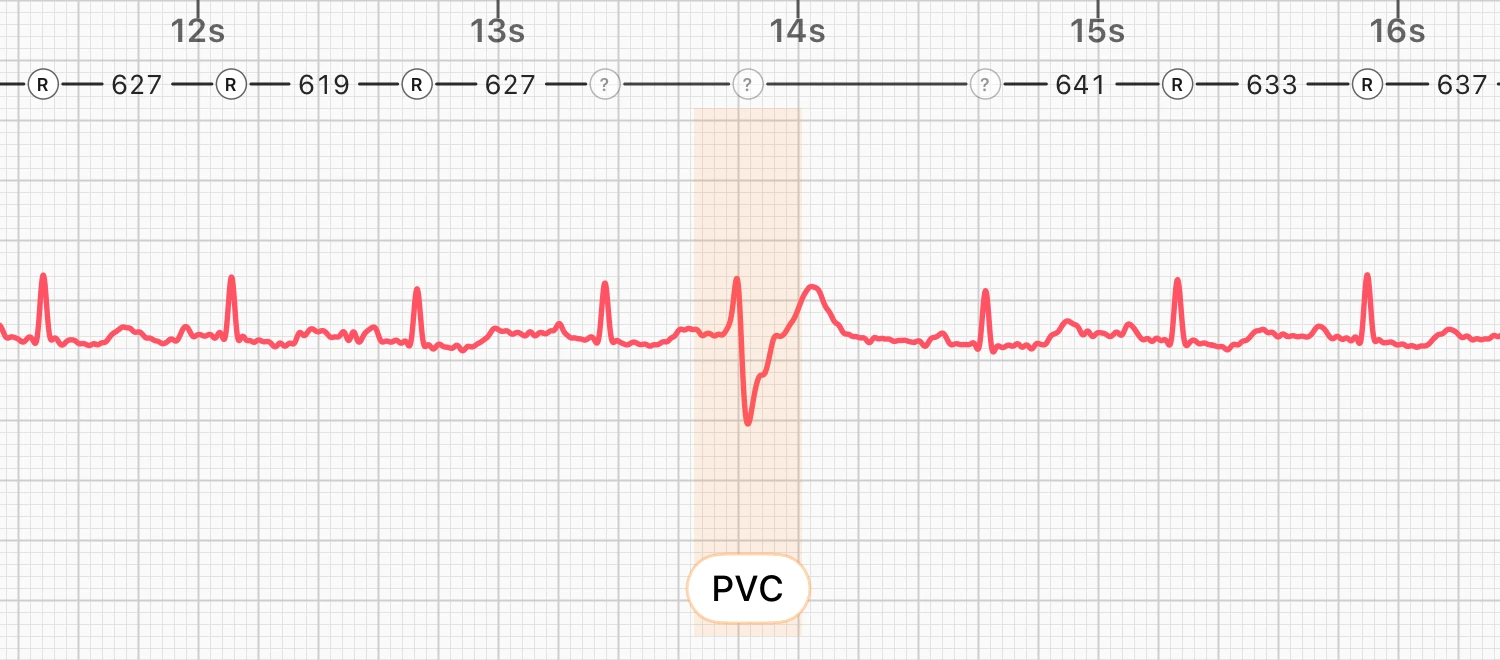
A flutter, a skipped beat, a moment where the rhythm stumbles. PACs are one of the most common reasons for that feeling, and many people have them without noticing at all. Here is what one looks like on a real single-lead recording, and how to spot it on your own Apple Watch ECG.
What a PAC is
A normal heartbeat starts in the sinus node, the heart's natural pacemaker in the upper right chamber. A PAC starts somewhere else in the upper chambers, the atria, before the next regular beat is due.1 The signal then travels down the normal pathway to the lower chambers, which is why the main spike of the beat usually looks familiar.
PACs are very common. In a study of adults aged 50 and older who wore a 24-hour monitor, only about 1% had no PACs at all.2 Most are harmless. Caffeine, alcohol, stress and tiredness can make them more frequent.1
A real example
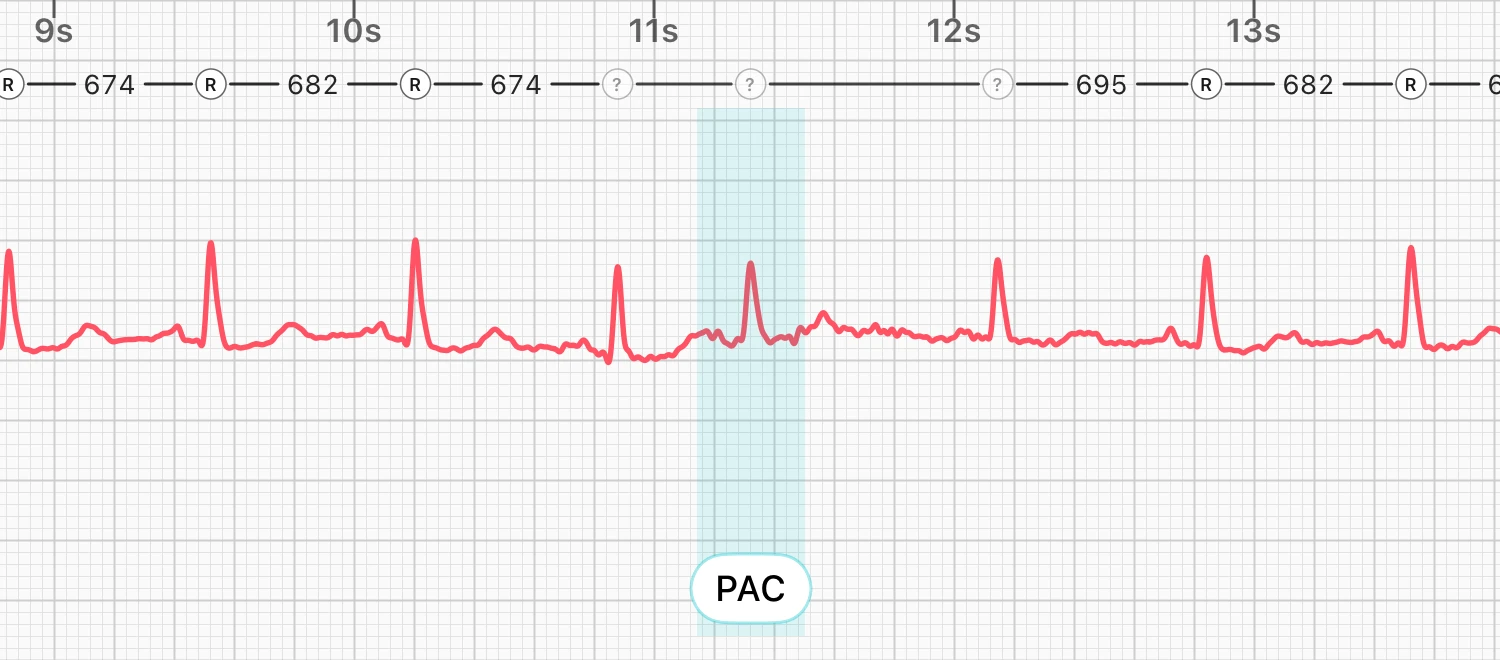
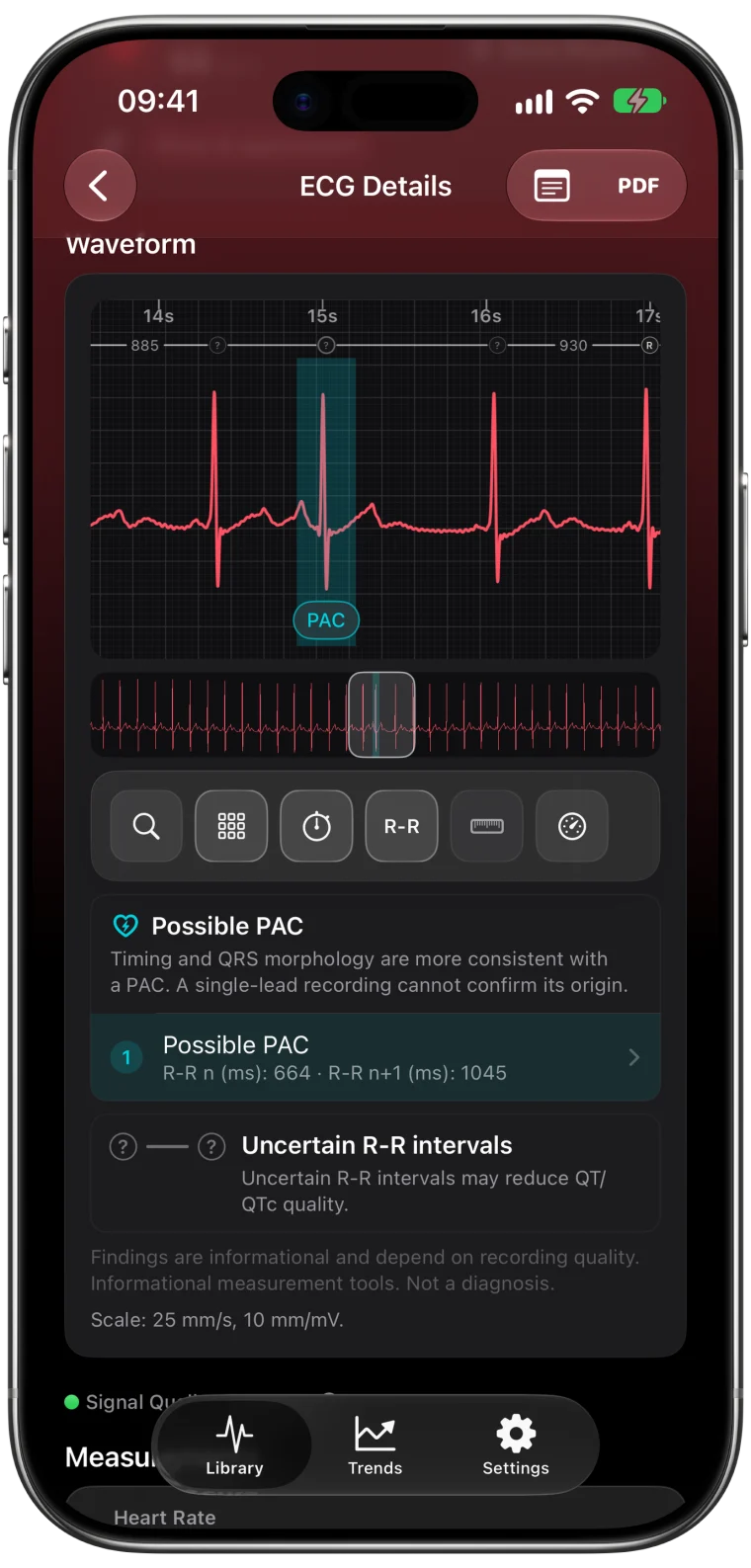
This is a real recording in lead I, the lead closest to what an Apple Watch records, with every beat labeled by experts. ECG Tracker+ ran the same analysis it runs on your recordings and marked one beat as a possible PAC. It is the beat the experts labeled as a PAC, and the app marked no other extra beats in the 30 seconds.
The regular beats here arrive about every 674 ms, a heart rate of about 89 bpm. The marked beat arrived only 443 ms after the beat before it. The gap after it lasted 824 ms.
Signs to look for
- It comes early. The gap before it is clearly shorter than the gaps between regular beats. In the example it is 443 ms instead of about 674 ms.
- It looks like its neighbors. The QRS, the tall spike, is usually narrow and similar in shape to the other beats, because the signal still uses the normal pathway into the lower chambers.3
- The P wave may look different or be hidden. A PAC has its own P wave, but because it comes early it can be shaped differently or buried in the T wave of the beat before.3
- The pause after it is usually shorter than a full compensatory pause. In the example, the gaps before and after add up to 1,267 ms, less than two regular beats of about 1,348 ms.4 After a PVC, the two gaps more often add up to about two regular beats.5
None of these signs is certain on a single lead. A PAC can occasionally look wide,4 and small P waves are easy to lose in noise. The PVC guide shows the opposite case, and the guide to PACs and PVCs compares the two.
How ECG Tracker+ shows it
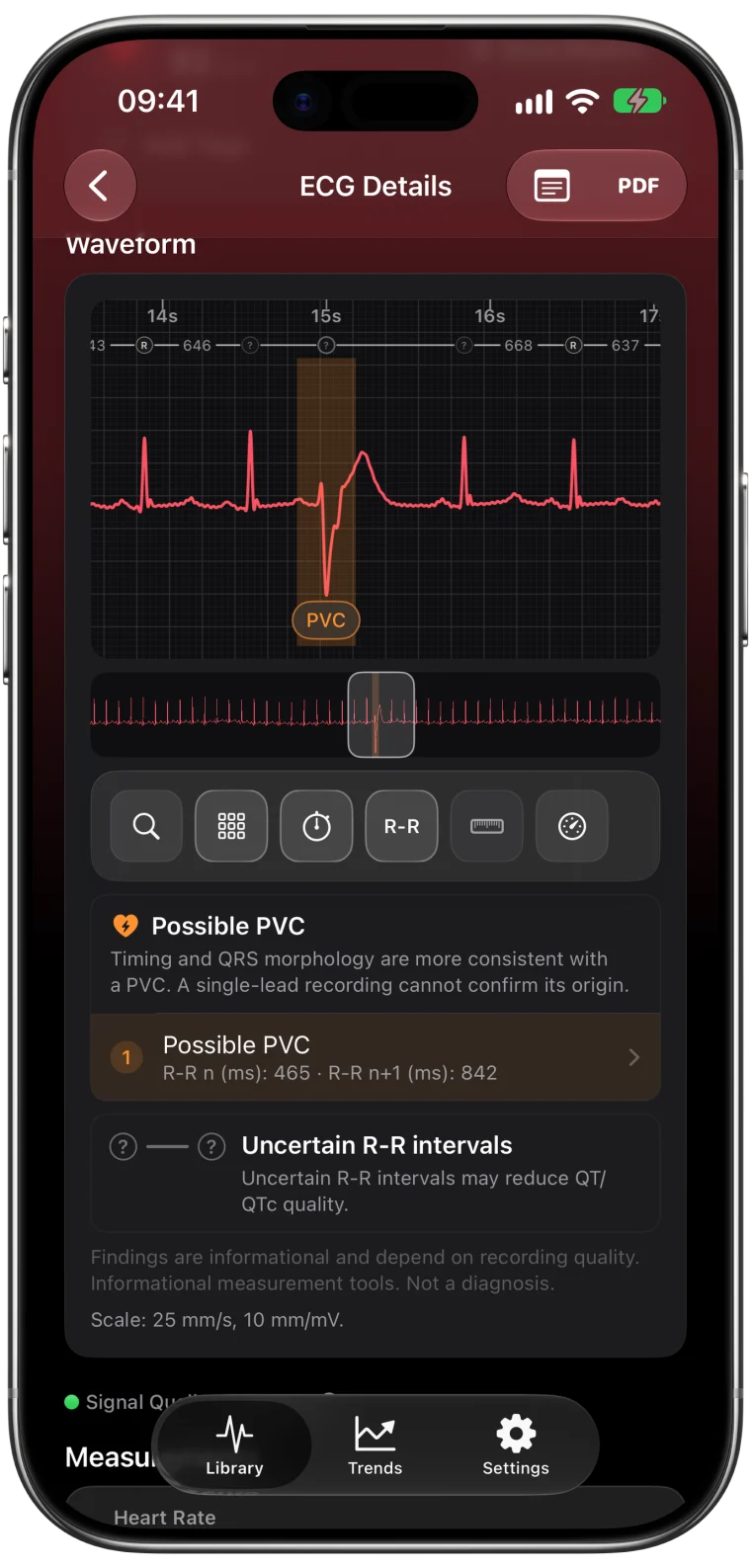
In the app, the beat is highlighted on the waveform with a Possible PAC label. Tap the finding to focus the waveform on that beat and see the R-R interval before and after it. Comparing those two gaps with the regular spacing is often the clearest clue.
Why the app says possible
On a single lead, the P wave that gives a PAC away is small, and noise can hide it or imitate it. Medical experts note that consumer ECG devices cannot currently classify PACs and PVCs the way a clinical assessment does.6 That is why ECG Tracker+ calls it a possible PAC. A marker is a cue to look closer and, if it matters to you, to show a clinician. It is not a confirmed finding.
When PACs form a pattern
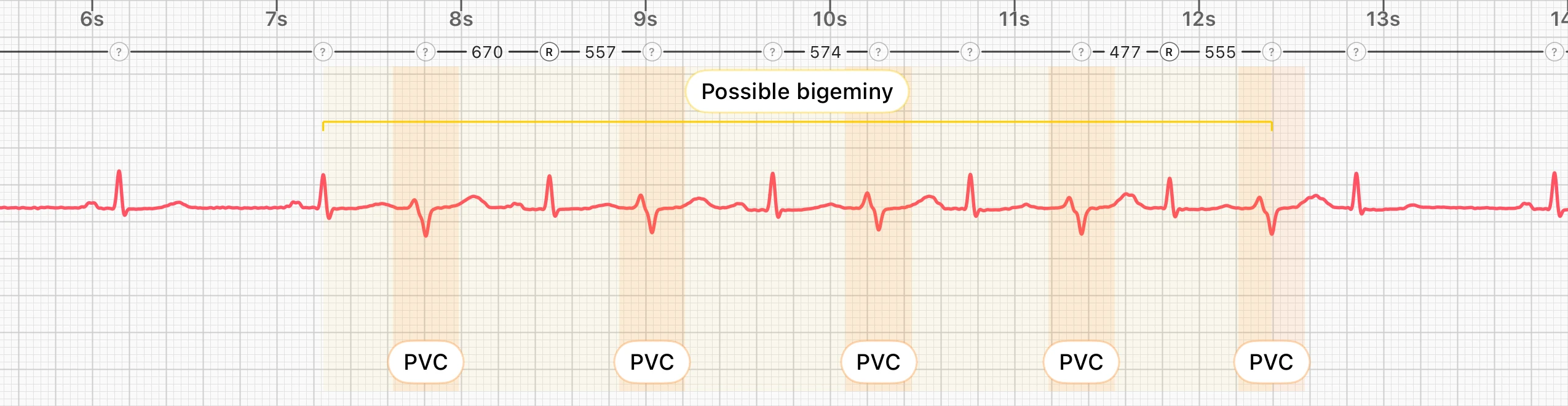
Sometimes early beats repeat in a steady rhythm, every second or every third beat. These patterns are called bigeminy and trigeminy. They can involve PACs or PVCs.
What one strip cannot tell you
A 30-second recording is a tiny sample of your day. One PAC on a strip says nothing about how often they happen. When clinicians want to know that, they use a Holter or patch monitor that records for a day or more.7 No 30-second strip can measure it.
Call emergency services if early beats come with chest pain, fainting, severe dizziness or shortness of breath. See a clinician if they happen often, get worse or worry you.1
Frequently asked questions
Can an Apple Watch ECG show a PAC?
Yes, a PAC often shows up on the waveform even when the result says Sinus Rhythm. Apple's ECG app does not label PACs. ECG Tracker+ marks possible PACs on your Apple Watch recordings for review.
Are PACs dangerous?
Occasional PACs are very common and usually harmless. A clinician looks at how often they happen, whether you have symptoms and your overall heart health.
What is the difference between a PAC and a PVC?
Both are early beats. A PAC starts in the upper chambers and usually has a narrow QRS that looks like its neighbors. A PVC starts in the lower chambers and usually looks wide and different, often with a longer pause after it.
Why does ECG Tracker+ say possible PAC?
A single-lead recording cannot always show the P wave clearly or where a beat started, and noise can resemble an early beat. The marker tells you where to look. A clinician confirms what it is.
Sources
- Cleveland Clinic: Premature atrial contractions
- Conen D et al.: Premature atrial contractions in the general population, Circulation 2012
- LITFL: Premature atrial complex (PAC)
- Merck Manual Professional: Ectopic supraventricular arrhythmias
- LITFL: Premature ventricular complex (PVC)
- ISHNE, HRS, EHRA and APHRS: Digital health collaborative statement on mobile ECG devices, 2021
- American Heart Association: Holter monitor