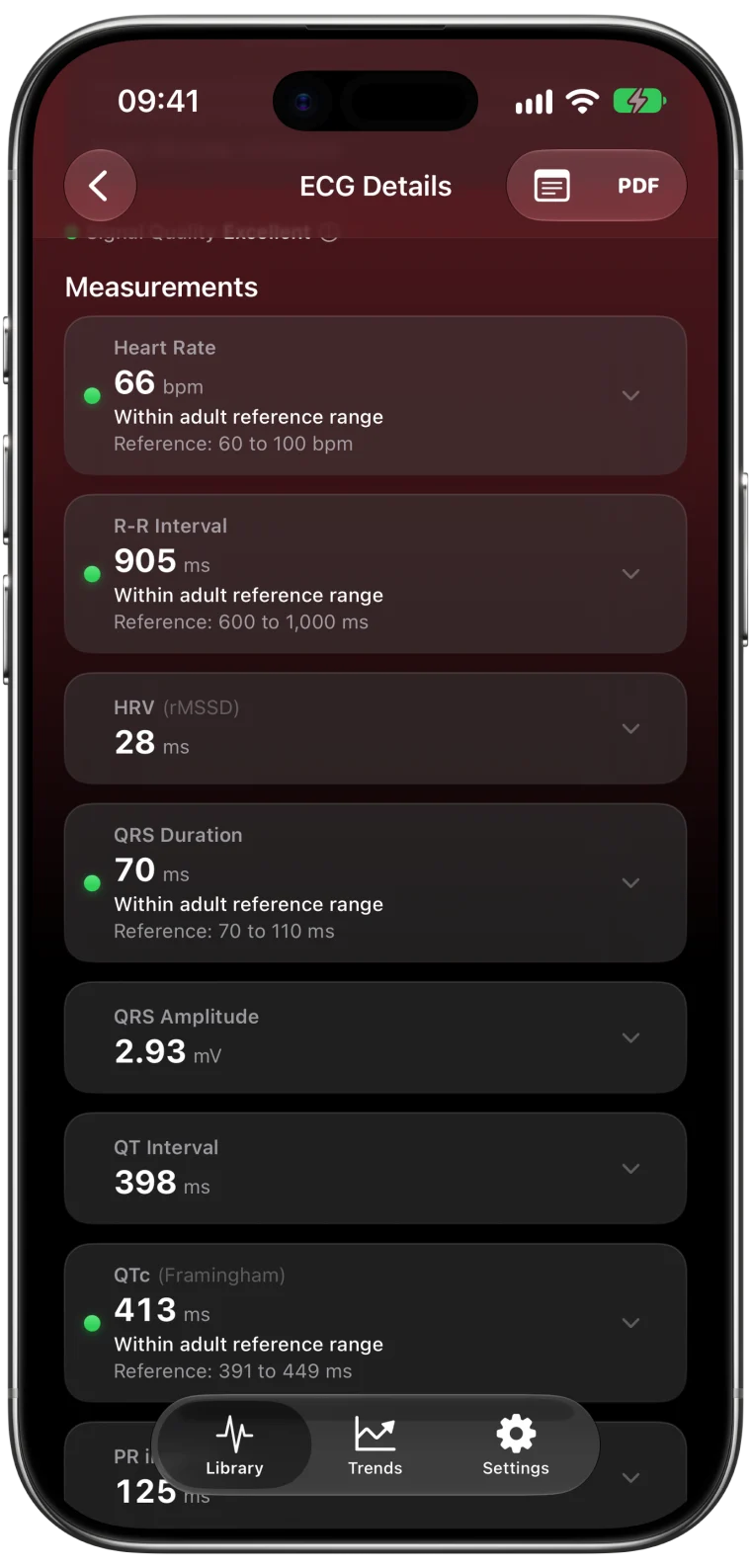
QTc is one of the most searched ECG measurements, and one of the most misunderstood. People taking medicines that affect the heart's rhythm, people with a family history and curious users all want to know the same thing: can I see my QTc on an Apple Watch recording, and what does the number mean? Here is a clear answer, including the parts that are less comfortable.
What QT measures
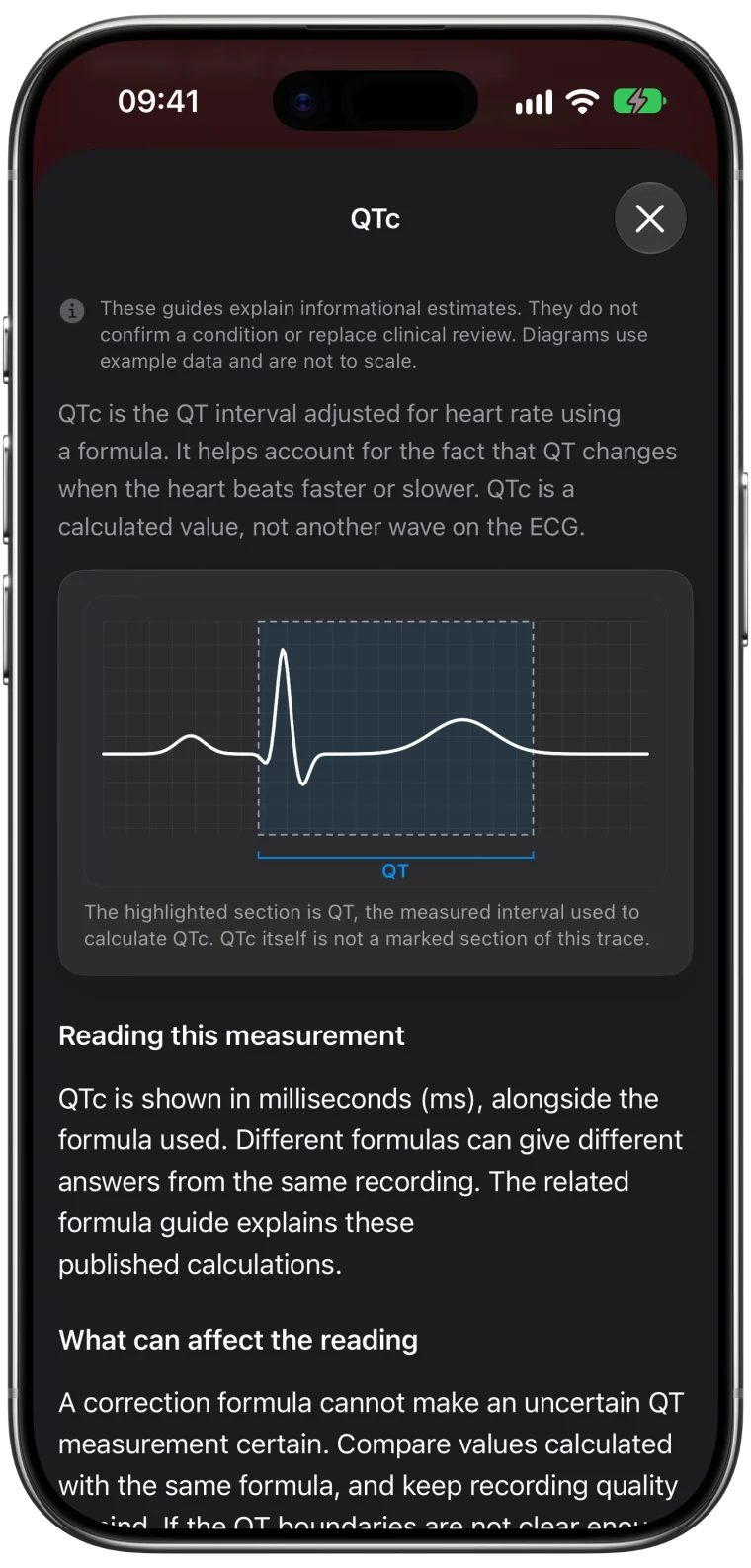
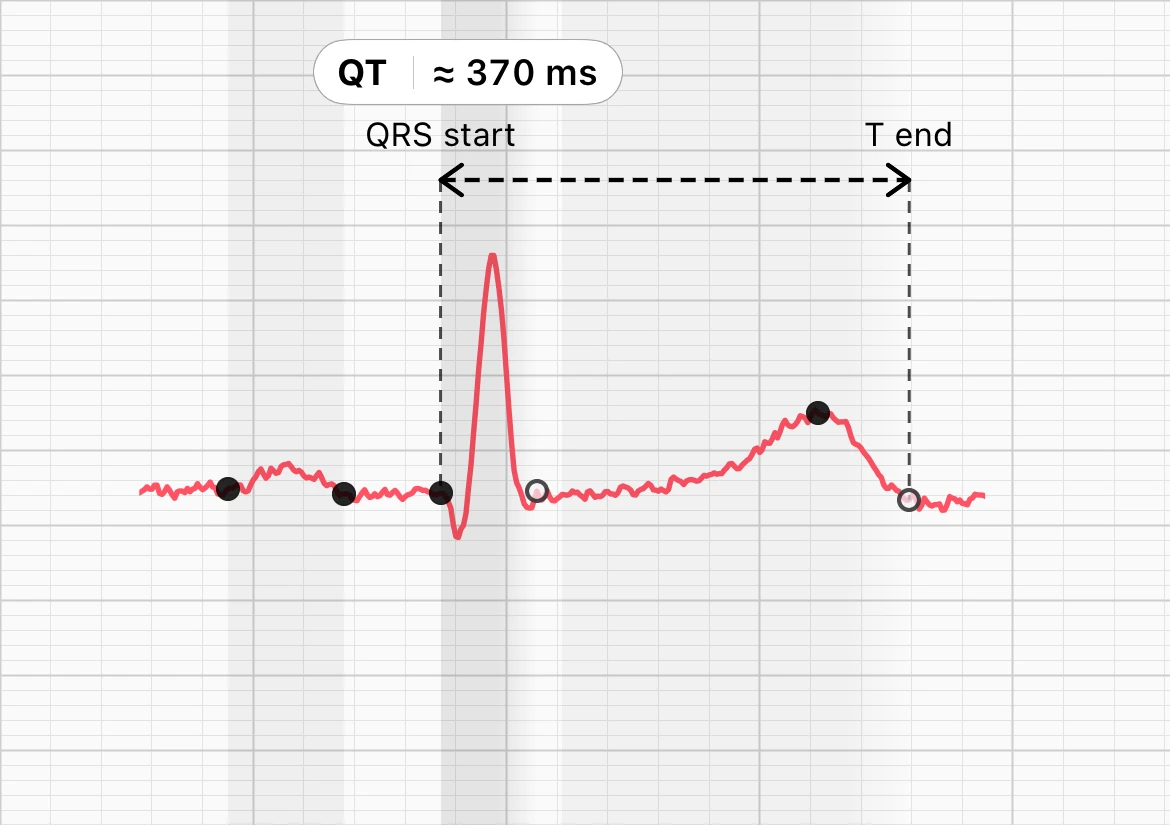
QT spans the time from the start of ventricular activation, the beginning of the QRS, to the end of recovery, where the T wave returns to the baseline. It is measured in milliseconds.
The hard part is the end. There is more than one accepted way to find where the T wave ends, and the two common methods differ by about 10 ms. Even specialists can place it differently on the same tracing, which is one reason QT values vary between people and between apps.1
QT on a real recording
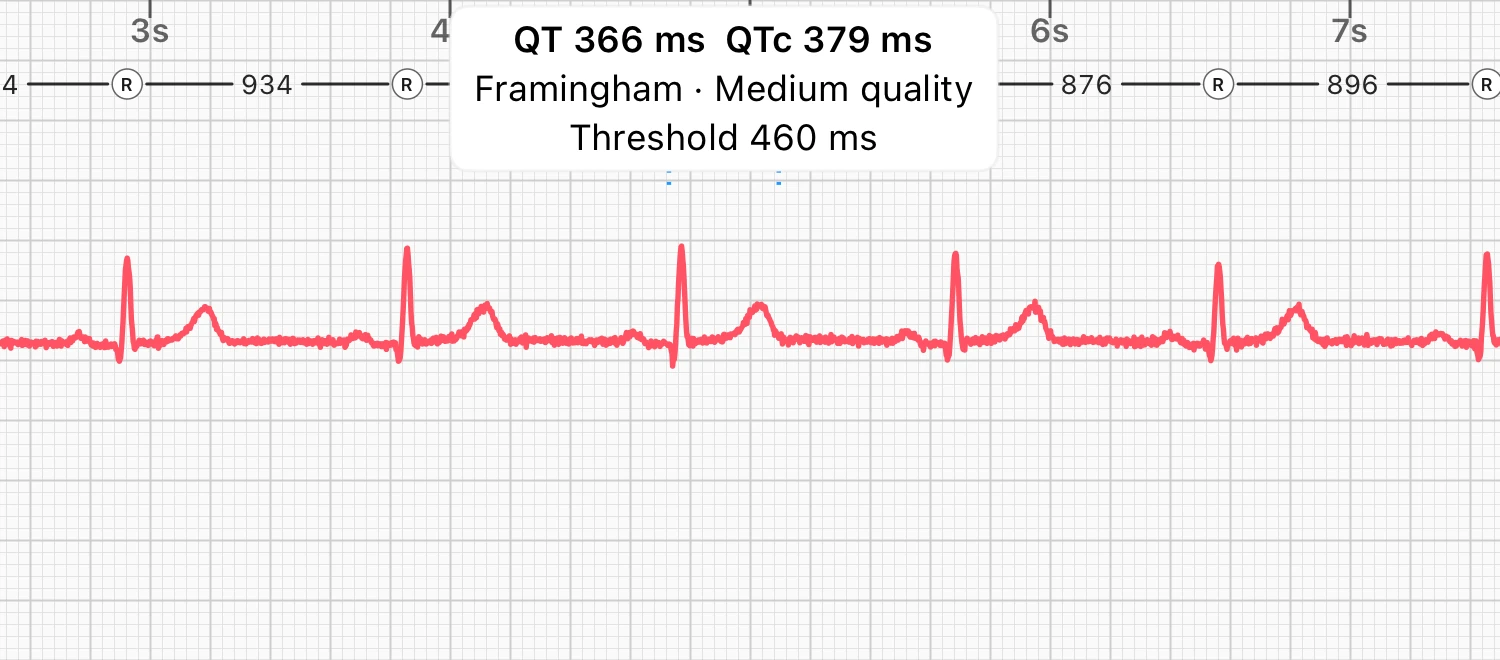
Here is QT measured on a real recording. It is a resting ECG in which cardiologists marked the start and end of every wave by hand. ECG Tracker+ analyzed lead I, the lead closest to an Apple Watch recording, with the same pipeline the app uses.
At a heart rate of about 66 bpm, the app measured a QT of 366 ms, which corrects to a QTc of 379 ms with the Framingham formula. From the cardiologists' marks, the same recording has a QT of 368 ms and a QTc of 381 ms. On a clean recording like this one the two agree within a few milliseconds. When the recording is noisy or the end of the T wave is flat, differences grow, which is why every QT in the app is an estimate.
Why QT is corrected
QT naturally gets shorter as heart rate rises and longer as it slows. A raw QT of 400 ms means something different at 50 bpm than at 100 bpm. Correcting for heart rate gives QTc, a value that can be compared across recordings made at different rates.
The main QTc formulas
With QT in seconds and the R-R interval in seconds:2
| Formula | Calculation |
|---|---|
| Bazett | QTc = QT / √RR |
| Fridericia | QTc = QT / ∛RR |
| Framingham | QTc = QT + 0.154 × (1 - RR) |
| Hodges | QTc = QT + 1.75 × (HR - 60), with QT in ms and HR in bpm |
A worked example shows how much the choice matters. Take a QT of 400 ms at 75 bpm, which is an R-R of 0.8 seconds:
- Bazett gives about 447 ms
- Fridericia gives about 431 ms
- Framingham gives about 431 ms
- Hodges gives about 426 ms
Same recording, a spread of more than 20 ms.
Which formula is best?
No formula is perfect. Bazett is the oldest and still the most widely used, but it tends to give a QTc that is too long at fast heart rates and too short at slow ones. In a large hospital study, Fridericia and Framingham corrected for heart rate more evenly than Bazett, which overestimated how many people had a prolonged QTc.2
That is why ECG Tracker+ lets you choose. In Settings → Analysis → Default QTc formula you can pick Bazett, Fridericia, Framingham, Hodges or Rautaharju, or leave it on Auto, which chooses a formula for you based on heart rate. The formula is always shown next to the value.
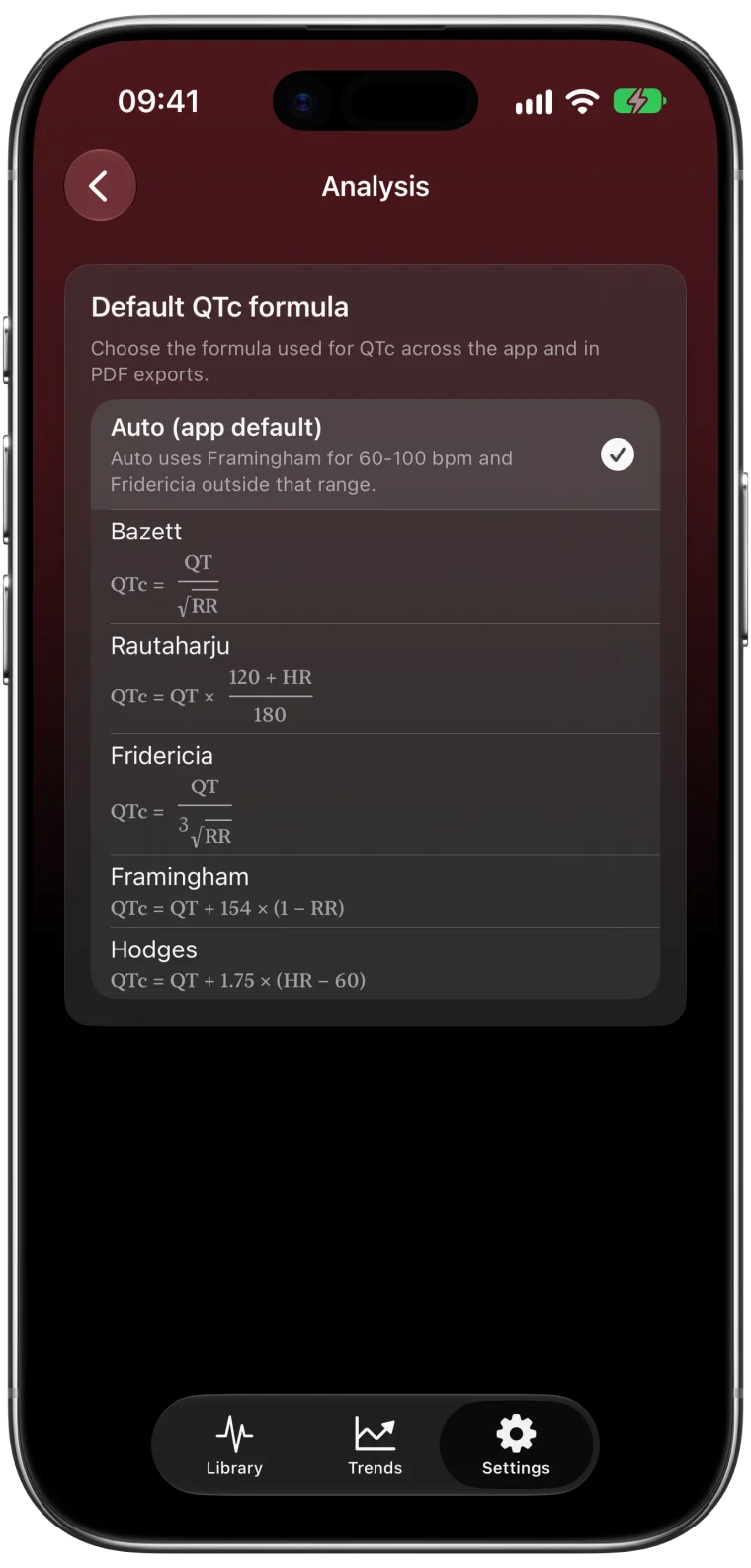
When you compare QTc values, always compare the same formula.
Typical QTc ranges
| QTc | What clinical references describe |
|---|---|
| About 350 to 450 ms (men), 360 to 460 ms (women) | The typical adult range3 |
| 450 ms or more (men), 460 ms or more (women) | Described as prolonged in a 2009 AHA, ACCF and HRS statement4 |
| Below 390 ms | Described as short in the same statement5 |
These thresholds come from 12-lead ECGs read by clinicians. A value from a single-lead watch recording is an informational estimate, so treat it as context, not a verdict.
What a watch recording can and cannot show
Studies have measured QT by hand on Apple Watch recordings. In one study of 100 patients, QT could be measured on the watch recording in 85% of patients, with a median absolute difference from the 12-lead value of 18 ms. For individual recordings, the differences ranged widely, with limits of agreement from −65 to +54 ms. The authors noted that lead I may not be the ideal lead for QT.6 In a 2026 systematic review of Apple Watch accuracy, four of the five studies that assessed QT reported shorter values from the watch than from the 12-lead ECG, with fairly wide limits of agreement.7
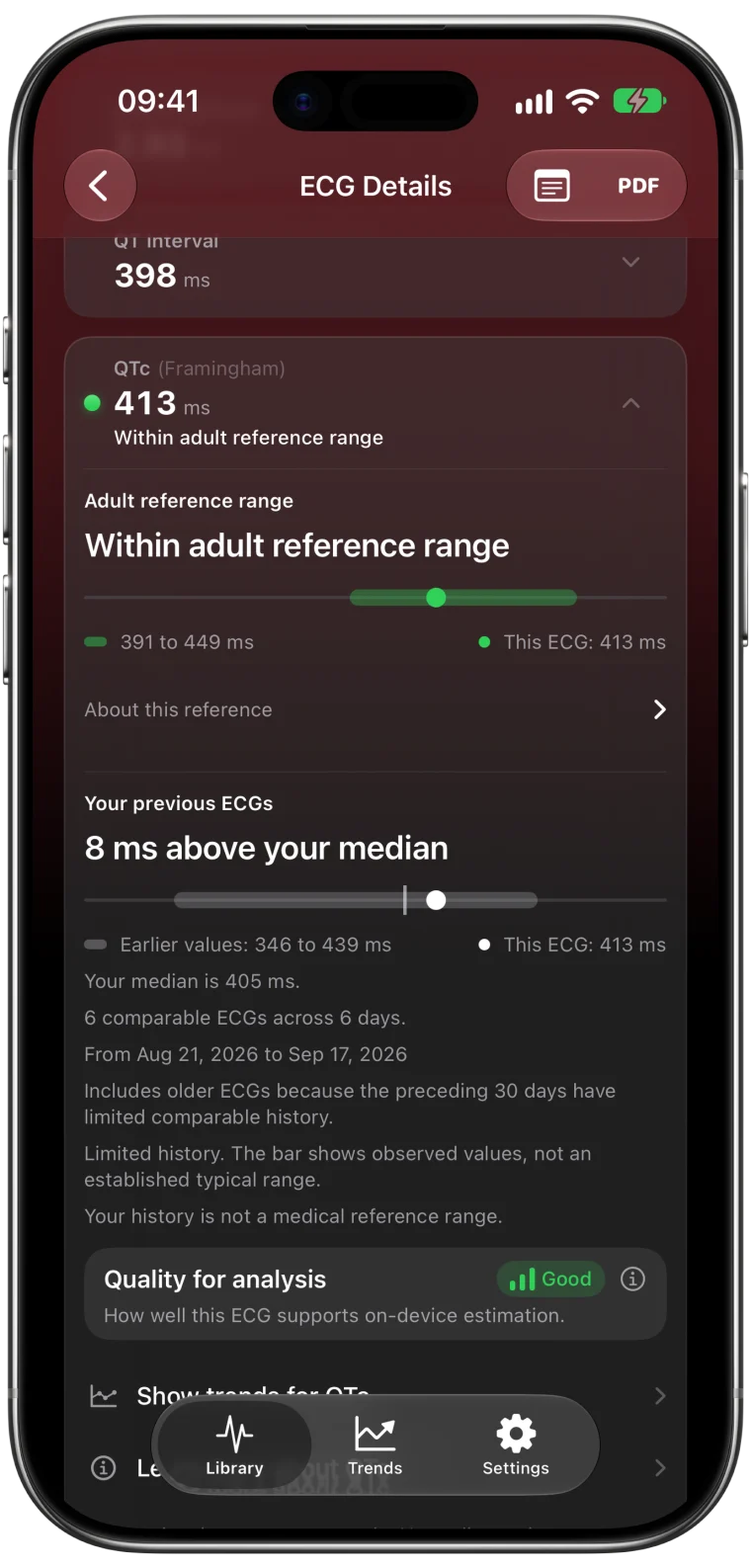
In practice this means an Apple Watch recording can be useful for following your own QTc estimates over time, while a clinical decision about QT belongs on a 12-lead ECG.
If you take medicines that affect QT
Some medications can lengthen QT, which is why clinicians sometimes monitor it. If you take such a medicine, your clinician decides how to monitor it. Do not start, stop or change any medication because of an app value. Bring your recordings to the conversation instead.
Call emergency services for chest pain, fainting, palpitations with dizziness or severe shortness of breath, whatever any app shows.
Frequently asked questions
Can an Apple Watch measure QT and QTc?
Apple's ECG app does not show QT. The recording often contains enough detail to estimate it, and ECG Tracker+ estimates QT and QTc from your Apple Watch ECGs when the T wave is clear enough.
What is a normal QTc?
Typical adult values are about 350 to 450 ms in men and 360 to 460 ms in women. These references come from clinical 12-lead ECGs.
Why do ECG apps show different QTc values?
Apps may place the end of the T wave differently, use different beats or use different correction formulas. The same recording can differ by 20 ms or more between formulas alone.
Can an Apple Watch ECG detect long QT syndrome?
No. Long QT syndrome is diagnosed by a clinician, using repeated 12-lead ECGs, a clinical risk score or genetic testing. A watch recording can be shared with your clinician as context.8
Sources
- ESC CardioGenomics Insights: How to measure the QT interval
- Vandenberk B et al.: Which QT correction formulae to use for QT monitoring?, Journal of the American Heart Association 2016
- Postema PG, Wilde AAM: The measurement of the QT interval, Current Cardiology Reviews 2014
- Reported thresholds from the 2009 AHA, ACCF and HRS recommendations, as cited in PMC8333696
- Short QTc threshold from the 2009 AHA, ACCF and HRS recommendations, as cited in PMC7838678
- Strik M et al.: Validating QT-interval measurement using the Apple Watch ECG, Circulation 2020
- Lambe R et al.: The accuracy of Apple Watch measurements, a living systematic review and meta-analysis, npj Digital Medicine 2026
- ESC 2022 ventricular arrhythmia guideline criteria, as reproduced in PMC11264164