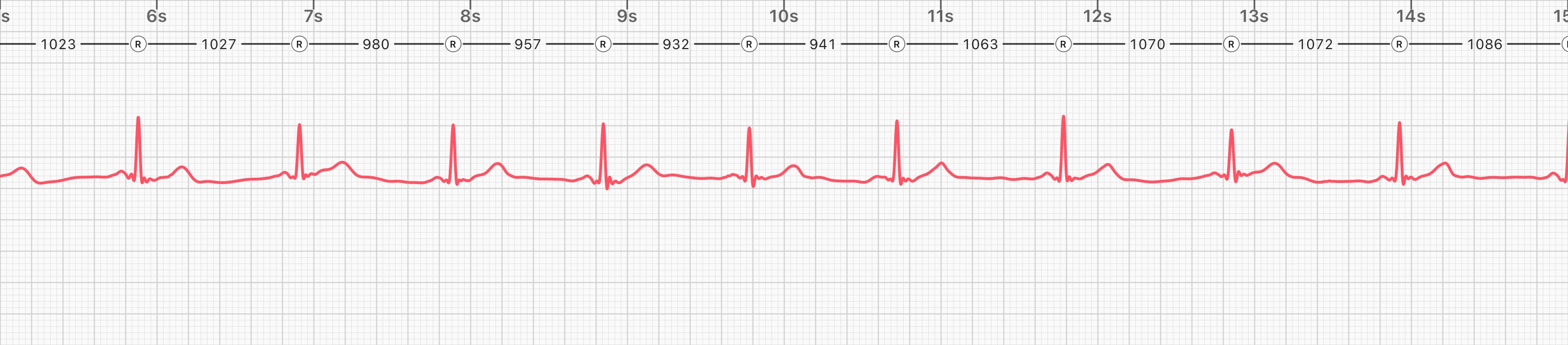
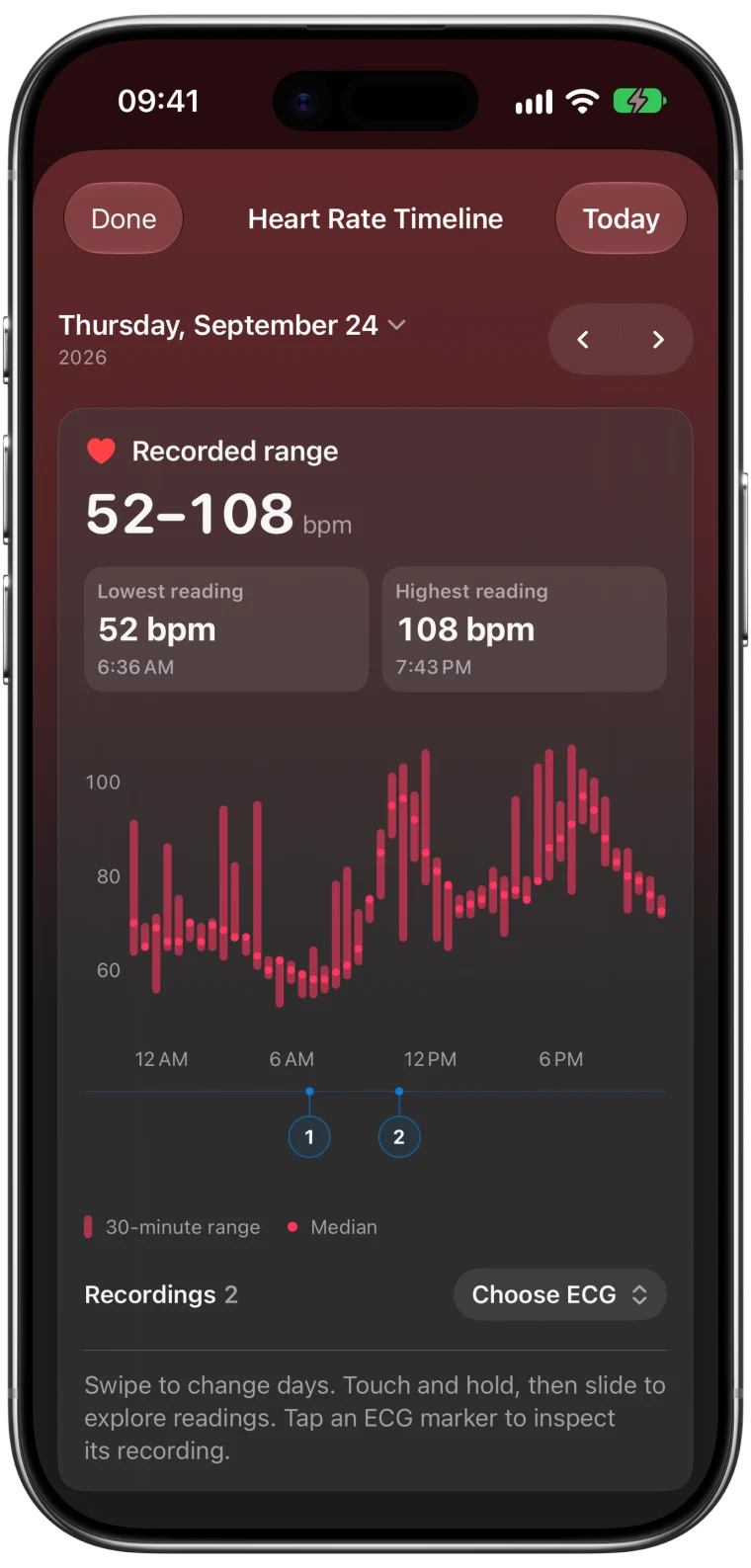
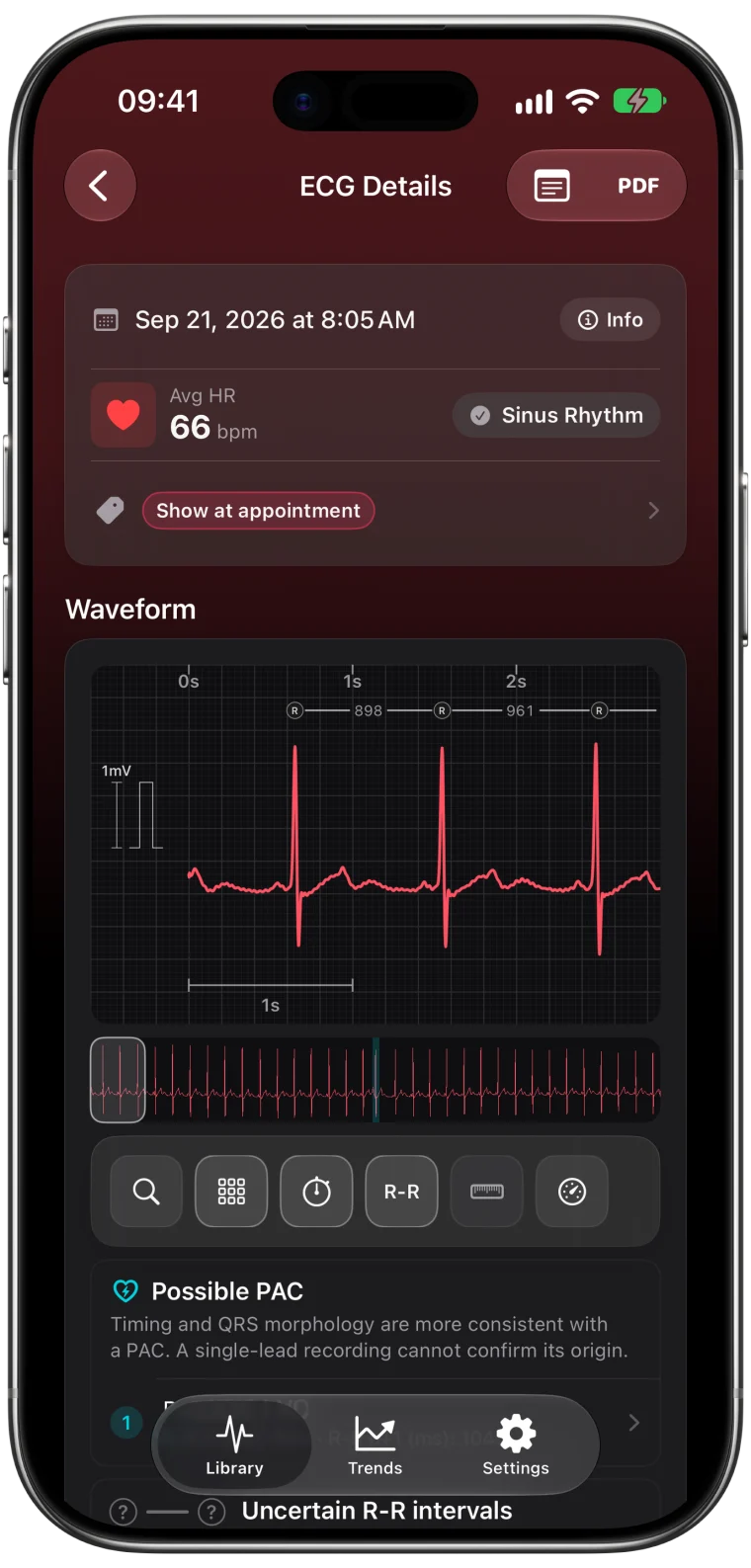
Heart rate is the first number most people look at, and on an ECG it is also the most dependable one. It comes straight from the timing of the tall QRS spikes, which stand out clearly even on a small single-lead recording. Here is how that number is made, using a real Apple Watch recording.
What heart rate and R-R measure
Each heartbeat draws a tall, sharp spike called the QRS complex. The peak of that spike is the R wave. The time from one R wave to the next is the R-R interval, measured in milliseconds.
Heart rate is simply the R-R interval turned into beats per minute:
- 60,000 ÷ R-R in ms = beats per minute
- An R-R of 1,000 ms is 60 bpm.
- An R-R of 750 ms is 80 bpm.
- An R-R of 600 ms is 100 bpm.
The heart rate for a whole recording is an average across all of its beats.
A real example
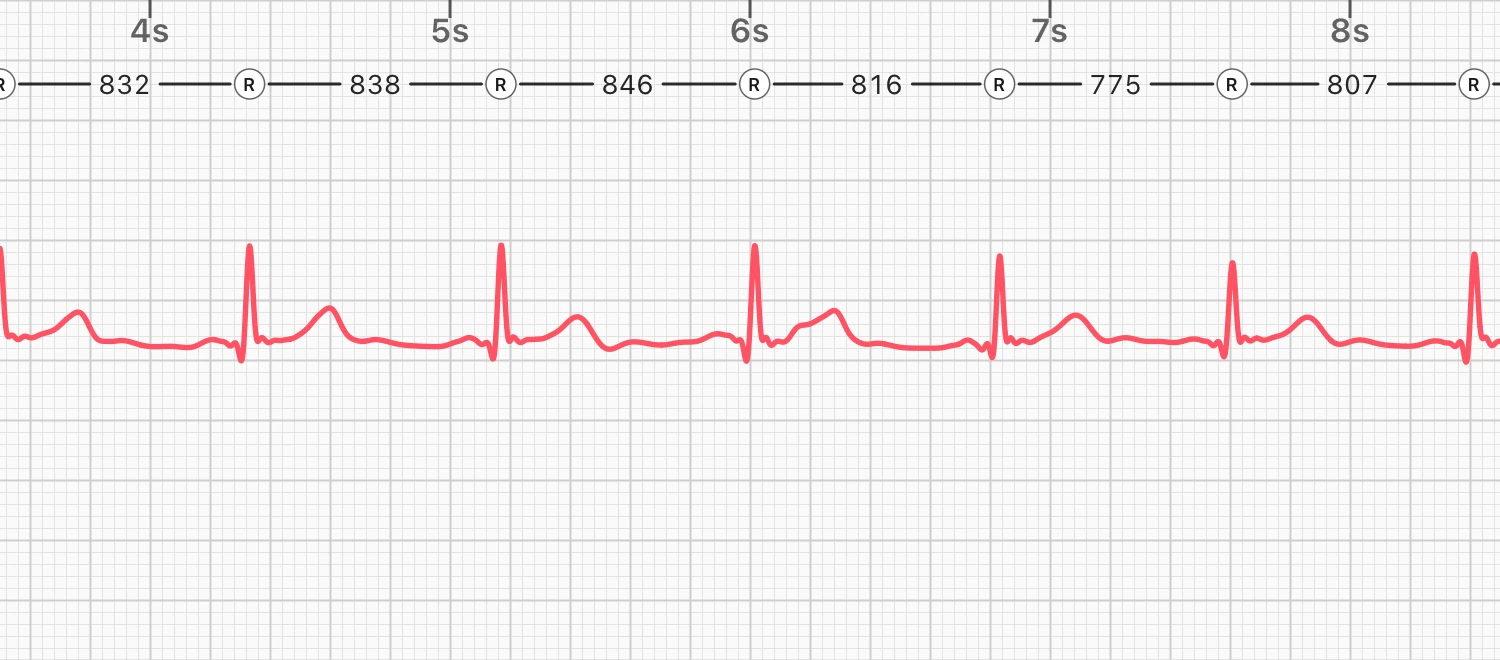
This is a real 30-second Apple Watch ECG, analyzed by ECG Tracker+ with the same analysis it runs on your recordings. Above the waveform, the app shows the R-R interval between every pair of beats.
In these five seconds the R-R intervals range from 775 to 846 ms. Across the whole recording they range from 770 to 883 ms, with a median of 828 ms. That works out to an average heart rate of about 73 bpm.
Notice that no two intervals are exactly the same. That is normal, and the next section explains why.
Why the gaps between beats are never equal
A healthy heart does not beat like a metronome. The time between beats shortens a little as you breathe in and lengthens as you breathe out. This gentle rise and fall is called sinus arrhythmia, and it is a normal variation, often most visible in younger and fitter people.1
The same variation is the raw material for heart rate variability. The HRV guide explains how it is summarized as rMSSD and SDNN.
What stands out is a sudden change: one gap much shorter than its neighbors, often followed by a longer one. That usually means an early beat, and the PAC and PVC guides show what that looks like.
Typical resting ranges
| Heart rate at rest | What it is usually called |
|---|---|
| 60 to 100 bpm | The conventional adult resting range2 |
| Below 60 bpm | Bradycardia, a slow heart rate3 |
| Above 100 bpm | Tachycardia, a fast heart rate3 |
A rate outside the range is not automatically a problem. Trained athletes often rest in the 40s or 50s, and heart rate rises naturally with activity, stress, caffeine or fever.3 What matters is the rate together with how you feel and what you were doing when you recorded.
On an Apple Watch recording, Apple's ECG app reports Low Heart Rate below 50 bpm and uses a separate result for high rates. The results guide covers each one.
ECG heart rate vs the heart rate in Apple Health
The heart rate in Apple Health mostly comes from the optical sensor, taken at different moments through the day. An ECG measures the electrical signal during its 30 seconds. The two often differ by a few beats per minute because they measure different moments. The heart rate history guide shows how to see both together.
How ECG Tracker+ shows it
For every recording, ECG Tracker+ shows the average heart rate with the lowest and highest rate during the 30 seconds, and the R-R interval between each pair of beats above the waveform. With calipers you can measure any interval yourself, as the grid guide explains. Over time, the heart rate card in Trends shows your median and how it moves.
Call emergency services if a fast or slow heart rate comes with chest pain, fainting, severe shortness of breath or confusion. See a clinician if your resting rate is often outside the usual range and you have not discussed it before.
Frequently asked questions
How does an Apple Watch ECG measure heart rate?
It times the R waves, the tall spikes of each beat. The average time between them, converted to beats per minute, is the heart rate for the recording.
What is a normal R-R interval?
At rest, R-R intervals of about 600 to 1,000 ms match the conventional range of 60 to 100 bpm. They vary slightly from beat to beat, which is normal.
Why are my R-R intervals not all the same?
Breathing changes the heart rate a little with every breath, so the intervals rise and fall. A single sudden short gap, followed by a longer one, is different and usually marks an early beat.
Is a heart rate below 60 bpm bad?
Not necessarily. Many healthy people, especially athletes, rest below 60 bpm. A slow rate with dizziness, fainting or unusual tiredness is worth discussing with a clinician.